
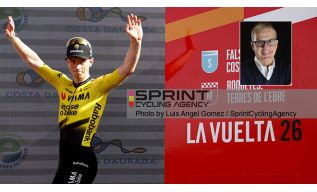
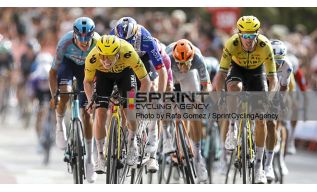
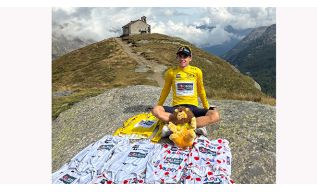
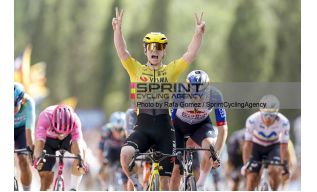
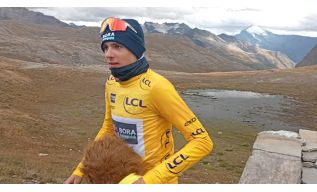

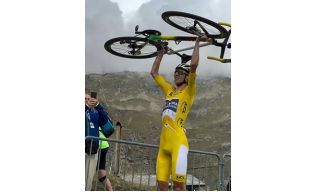

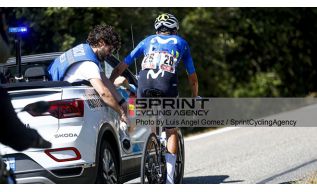
















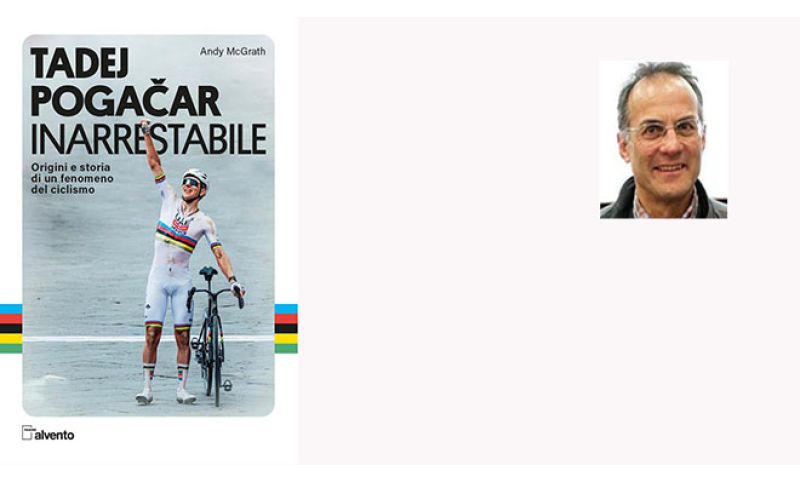
Pogacar, in Slovenian, means talkative. I don't know Tadej Pogacar, I don't know if he's talkative or reserved, verbose or silent, discreet like Coppi or volcanic like Bartali or polyglot like Merckx. What's certain is that he speaks a lot – and very clearly – through his actions, which for him are pedal strokes like the fairy tales of Gianni Rodari, in heaven and on earth. And if Pogacar weren't talkative, there are others who write about him, for him, with him. This is the first of two installments covering two books about Pogacar.
-
Portugal, Volta ao Algarve, February 2019. First in the second of five stages, then first in the general classification and first in the young riders' classification, as well as third in the mountain classification and sixth in the points classification. "To be honest – admits Andy McGrath in the introduction to his "Tadej Pogacar Unstoppable" (Alvento pages, 336 pages, 23 euros) – I didn't put much weight on our first meeting" (and his first professional victory) "and I didn't go home convinced that he would become a world-class champion". Instead "he is the young yet dominant force of professional cycling", "he invades every field and challenges any opponent, seemingly improving season after season".
Everyone likes Pogacar. Because he wins, convinces, overwhelms. Because he attacks alone, from far away, from a distance. Because he is polite, smiling, attentive. I like McGrath too. He's a precise, curious, respectful journalist and writer (English). One of those who goes, sees and writes, one of those who speaks, records and reports, one of those who studies, investigates, connects. One of those from the road. One of those who digs and extracts. Stones or nuggets, tufa or diamonds, it depends. But they continue to dig and extract. Until – precisely – they connect.
McGrath behaved this way – I recall his book on Tom Simpson, another on Franck Vanderbroucke – this time too. He dug, extracted and connected. He starts again from the twentieth stage of the 2020 Tour de France (a clarification: Andy uses the simple past in English, I prefer – in the Latin manner – the historical present, a matter of latitudes). In the general classification Tadej is second, 57 seconds behind his compatriot Primoz Roglic. Two stages remain before the final finish in Paris, the twentieth is a time trial, 36.2 km, the twenty-first and final arrives in Paris like a carousel, so only one remains, this time trial, and Roglic, if he's not the favorite, is certainly not the underdog. Pogacar is on the bus, the mechanics in the truck. He's preparing himself, concentrating, breathing, they're assembling a white Colnago like the white jersey of the best young rider. "Why?" Tadej asks his staff, "Don't they have faith in me?". The beautiful thing (for Pogacar, not for Roglic) is that Tadej wins, convinces, overwhelms with 1'21" over Tom Doumulin and Richie Porte, 1'31" over Wout van Aert and 1'56" over Roglic. Match, game, contest. The next day, in Paris, he displays a yellow Colnago, which the mechanics, in any case, had already prepared.
Then McGrath resumes from childhood, from the junior years to those in the continental ranks, returns to his debut in 2019 and his first triumph in 2020, then retraces the ascent – unstoppable, precisely – through all of 2025. Grand Tours and smaller races, northern classics, World and European Championships, to be picky he's still missing an Olympics. Yet it's not the quantity nor the quality that amazes, it's the way he wins: he departs and he's gone. Where he declares it and maintains it, where he feels it and improvises, where he wants it and flies. "He's one in a million": words from Matteo Trentin, page 317.
"Tadej Pogacar Unstoppable" is a mosaic constructed through races and riders, teammates and rivals, technicians and journalists, parents and family members, friends and doctors. It's not just a paean or a eulogy, there are also delicate and definitive questions, because always in front of the top of the class there's someone – especially in cycling – who wonders if it's all his own doing, if he's just living on bread and water, if in short there's reason to trust him. And here too McGrath, as much as he can, digs. Among coaches and trainers, methods and schedules. Names, surnames, quotation marks, data. Journalism.
When will Pogacar no longer be unstoppable? He's signed through the end of 2030, when he'll be 32 years old. But the day will come, probably sooner. Del Toro, Seixas, someone else, but yes. Only then can this book be revisited and updated. But up to here it stands to Pogacar's historiography as the Pillars of Hercules stood to ancient geography.
(end of the second installment – end)



 4
4
 4
3
3
14
14
20
20
2
2
4
3
3
14
14
20
20
2
2

 Ritratti
 Oscar
Oscar Albi d'Oro


Se sei giá nostro utente esegui il login altrimenti registrati.