

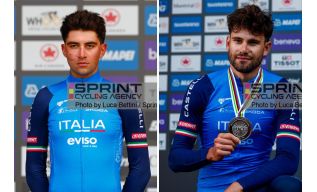













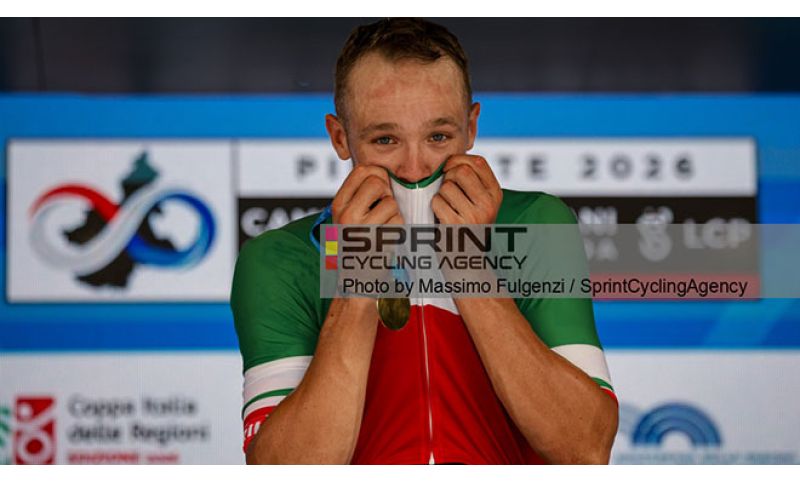
There is an ancient, almost ritual way of looking at the Italian Championship: waiting for the winner's name, seeing who will wear the tricolor jersey for a year, imagining that green, white and red within the group of major international races. It is the most natural reading, the emotional one, the one that belongs to the deep memory of cycling. But today, alongside the race told by the result, there exists a second race: the one that numbers allow us to read beneath the surface.
The Italian professional road championship, in fact, is not an ordinary race. By its very nature it should represent the place of maximum concentration of the national cycling movement: the best Italian riders, WorldTour teams, Professional teams, Continental teams, rising generations and those that endure. This is why the Startlist Quality Score, an indicator developed and already discussed in previous articles, does not merely measure the technical quality of a starting list. In the case of a national championship, it can become something more: a snapshot of the competitive density of the entire Italian professional cycling sector.
The basic formula is simple, but very effective. The Startlist Quality Score can be expressed as: SQS = Σ wᵢ
where wᵢ is the weight assigned to each rider based on his position in the PCS ranking: 50 points if in the top 10, 35 if in the top 25, 20 if in the top 50, 10 if in the top 100, 5 if in the top 200, 2 if in the top 500, 1 if in the top 1000, 0 beyond that threshold. What matters, therefore, are not the absolute ranking points, which can vary from one season to another, but the relative placement of athletes. It is precisely this approach that makes the data comparable over time. Applied to the Italian Championship, the number can take on an even denser significance. If the value rises, it means that many Italian riders positioned in the upper tiers of the international ranking are at the start. If it falls, it means that this concentration thins out. Not necessarily because individual talents are lacking, but because the movement, as a whole, appears less deep, less compact, less capable of presenting in the same event a critical mass of high level.
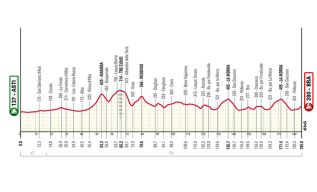
In 2026 the Italian Championship Asti-Cuneo registers a Startlist Quality Score of 211. The data should not be read as an isolated collapse, but as part of a trend. The 2010-2026 series shows three fairly distinct phases. Between 2010 and 2013 the average is 163.3 points, with the minimum in 2011 at 114: a phase of low competitive concentration. From 2014 to 2020 the most solid period opens instead: the average rises to 329.0, with the peak in 2018 at 407. It is the season in which the tricolor appears closest to its ideal function: not only to award a jersey, but to gather a substantial part of the national elite. From 2021 to 2026 the picture changes. The average drops to 237.3 points. Even more striking is the comparison between the strong five-year period 2016-2020 and the more recent 2022-2026: we go from 351.4 to 228.0. The reduction is approximately −35.1%. In sporting terms, it means that the Italian Championship of recent years can no longer express the same competitive density of the previous cycle.
To make the phenomenon more readable, we can introduce a further derived indicator, the IDCI – Italian Competitive Density Index, calculated as:
IDCIₜ = (SQSₜ / SQSmax) × 100
where SQSmax is the maximum value observed in the series considered. In our case the maximum is 2018, with 407 points. 2026 therefore produces:
IDCI₂₀₂₆ = (211 / 407) × 100 = 51.8
The meaning is immediate: the 2026 Italian Championship expresses little more than half the competitive density recorded at the highest point of the recent series. It is not a definitive sentence on Italian cycling, but it is a strong signal. Because the problem is not establishing whether Italy still has valid riders. It does. The point is understanding whether the system is still capable of producing a broad, continuous, visible, present elite. The tricolor jersey remains a powerful symbol. It continues to speak of identity, belonging, history, national pride. But the numbers ask us to go beyond the liturgy. If the Italian Championship is the day when the country's cycling should look at itself in the mirror, the mirror of 2026 returns an intermediate image: not a terminal crisis, but a rarefaction. Less density, less depth, less concentration of high level compared to the best phase of the previous decade. It does not replace the emotion of the race, but makes it more conscious. The tricolor does not only measure who wins. It also measures how many, behind him, are truly capable of contending for it with international weight. And so the figure 211 is not just a number. It is a question posed to the movement: Italian cycling must certainly seek the next champion. But above all it must rebuild the group that makes him less alone.

 3
3


 3
3


 6
6
5
5
19
19
1
1
3
3
4
4
2
2
6
6
5
5
19
19
1
1
3
3
4
4
2
2

 Ritratti
 Oscar
Oscar Albi d'Oro

