















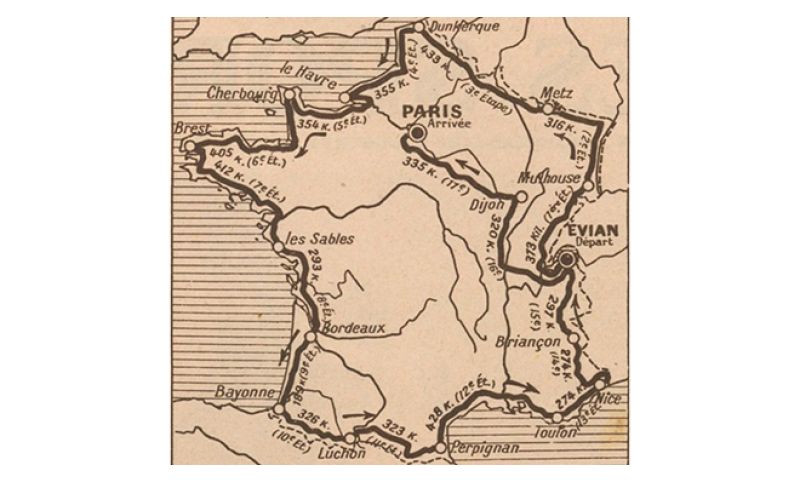
The Tour de France 2026 will experience its 27th Grand Départ abroad on July 4th. Exactly a century ago, in 1926, the race experienced a historic moment when the start was given from Evian, for the first time away from Paris, the headquarters of the organizing newspaper L'Auto.
Among other anniversaries that stand out in Tour history, the editions marked by the number 6 offer pages worth revisiting: the atypical victory of Roger Walkowiak in 1956, the heroic finale of Raymond Poulidor's fourteenth and final participation at the age of 40 in 1976, and the changing of the guard in 1986 between five-time French winner Bernard Hinault and the first American winner, his La Vie Claire teammate Greg LeMond. Thanks to our friends at ASO, we will retrace these events in a sort of countdown to the great appointment in Barcelona.
THE LONGEST TOUR
Edition: 20th
Dates: June 20 - July 18, 1926
Mountain passes: 17
Distance: 5,745 kilometers between Évian-les-Bains and Paris
Average speed: 24.063 km/h
Podium:
1. Lucien Buysse (Bel / Automoto-Hutchinson)
2. Nicolas Frantz (Lux / Alcyon-Dunlop)
3. Bartolomeo Aimo (Ita / Alcyon-Dunlop)
Yellow jerseys: Lucien Buysse (10), Gustave Van Slembrouck (7)
Stage winners: Nicolas Frantz (4), Jules Buysse, Joseph Van Dam (3), Aimé Dossche (2), Bartolomeo Aimo, Félix Sellier, Camille Van De Casteele, Gustave Van Slembrouck, Adelin Benoît (1)
The twentieth edition of the Tour de France is the first to start not in Paris, but in Évian-les-Bains. The peloton completes a full lap of the national territory, returning to Evian (15th stage), before reaching the capital. It was only in 1951 that a Grand Départ in the provinces, at Metz, took the start away from Paris.
The 1926 Tour de France was also the longest of all time, with 5,745 kilometers to cover (5,560 km for the previous record in 1919) in 17 stages, averaging 338 km per stage. Its distance and difficulty make it the second slowest Grande Boucle in history, with an average speed of 24.063 km/h.
Another novelty: the participation of a Japanese rider, Kisso Kawamuro, who had been in France since 1918 and was registered as a road tourist. He did not complete the first stage, just as in 1927. Only in 2009 did two Japanese riders finish the Tour: Fumiyuki Beppu (112th) and Yukiya Arashiro (129th).
The sole winner of the third stage (Metz - Dunkerque), Gustave Van Slembrouck, stole the yellow jersey from its first wearer, his compatriot Jules Buysse, and held the symbol of leadership until the ninth day. The legendary tenth Pyrenean stage, between Bayonne and Luchon, would prove fatal to his chances.
On July 6th, 76 riders started in freezing rain at 2 in the morning. The mud and polar cold added difficulty to a 326 km route featuring giants called Aubisque, Tourmalet, and Aspin. By midnight, 47 riders had reached Luchon. Some would have finished by bus: 22 athletes abandoned this Dantean stage, considered the most difficult in history.
The Aubisque struck down leader Gustave Van Slembrouck and two-time champion Ottavio Bottecchia, a victim of the cold. Starting uphill, Jules Buysse was followed by Albert Dejonghe and Odile Tailleu, defeated by hunger on the Tourmalet. Buysse flies toward the Aspin and reclaims the yellow jersey.
Winner again between Luchon and Perpignan the next day, this time ahead of his brother Jules, Lucien Buysse overtook his pursuers in the general classification. He subsequently managed to maintain his lead by winning his first and only Tour de France, a year after finishing second.
Nicolas Frantz, winner of 4 stages, and Bartolomeo Aimo, close to snatching second place from Frantz on the final day, took the podium. The Luxembourger and the Italian finished second and third for the second time. Frantz got his revenge by winning the next two editions (pictured here on the right in 1927).
Despite the podiums of Romain Bellenger, Georges Cuvelier, and Marcel Bidot, France did not win any of the 17 stages, which were won by the Belgians (12), Luxembourger Frantz (4), and Italian Aimo (1). It was the first Tour without a national victory, a fact that would not be repeated until 1999.

 2
2


 2
2


 2
2
1
1
8
8
1
1
7
7
2
2
1
1
8
8
1
1
7
7

 Ritratti
 Oscar
Oscar Albi d'Oro

