















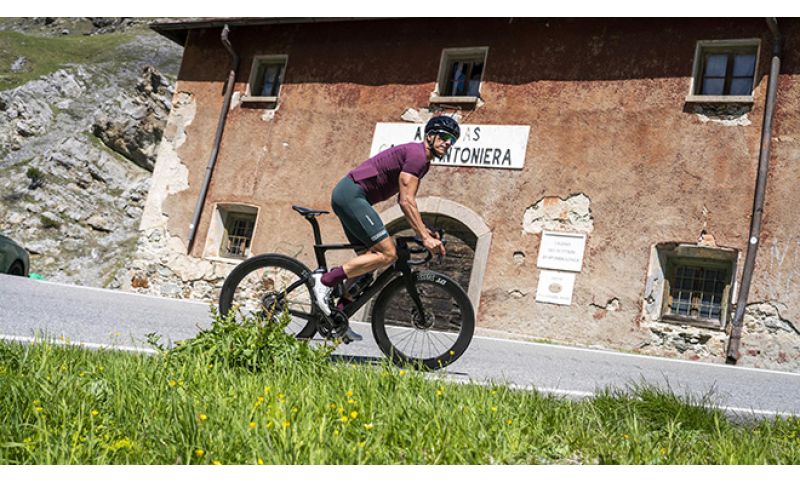
Every spring the Bormio area stops being simply one of the most beautiful destinations in the Alps and becomes something more: the starting point for three of the most iconic climbs in world cycling. That moment has finally arrived: after the opening of the Mortirolo, both the Stelvio (from Friday, May 22) and the Gavia (from Wednesday, May 27 for the route from Santa Caterina Valfurva) are passable again and from this week, for the first time in the season, the three passes that have written pages of history in the Giro d'Italia can be tackled.
THREE CLIMBS, NONE LIKE THE OTHER
It takes just a few kilometers to understand that each of these climbs is unique in its own way. The Stelvio is grand by definition: 2,758 meters, Italy's highest motorable pass, 21 hairpin turns that climb from the Bormio side with an almost geometric regularity before opening onto a panorama that takes your breath away even before the effort. It is a climb that carries with it the weight of the names that have traversed it—Coppi, first of all—and that still manages, every time, to seem worthy of its past.
The Gavia is different in character and atmosphere. The 24.8 kilometers that climb to the 2,652-meter pass flow along a narrow road, often silent, in the heart of the Stelvio National Park. It is not a climb that imposes itself by force. And for those who know cycling, there is an image that does not fade: the 1988 Giro stage, the snowstorm, the group crumbling in sub-zero temperatures while Erik Breukink accomplishes the feat on the descent toward Bormio.
The Mortirolo, finally, does not need altitude to command respect. The 12.5 kilometers from Mazzo speak for themselves: gradients touching 20%, an average that leaves no respite, and the 1994 of Pantani etched in the collective memory of anyone who loves this sport. It is considered among the toughest passes in Europe, and the reputation is well-deserved.
A SEASON THAT ENTERS ITS PEAK
Having all three passes open means not only being able to climb them, but also experiencing them in a context that rarely finds parallels in the Alps. The Enjoy Stelvio Valtellina, the free and non-competitive event that from May 30 to September 19 closes the major passes in the province of Sondrio to motor traffic, dedicates an appointment to each: the Gavia on June 5 and August 30, the Mortirolo on June 9 and August 28, the Stelvio on September 19.
But the most celebrated Cima Coppi in the history of the Giro Rosa can also be encountered in other ways this summer: on June 7 with the Stelvio Santini, from June 26 to 28 with the Mogast, on July 12 with the Re Stelvio Mapei, and on August 29 with the homonymous Scalata.
For those seeking a challenge that extends beyond a single day, the three passes could not be anything other than the heart of the Stelvio Epic Rides: ten climbs to complete over the course of the entire summer, at your own pace. But the Alta Valtellina has much more to offer than what the three most celebrated names suggest: alongside the three cycling giants, the challenge includes less celebrated ascents. The Strada dei Forni from Santa Caterina Valfurva, the Passo della Forcola, the Fumero, the ascents to the Cancano Lakes, to the Forte di Oga, to Bormio 2000, and to Monte da Scleva are not compromises for those who don't feel up to tackling the Stelvio: they are climbs with their own character, landscapes that cannot be found elsewhere, and the ability to surprise even those who believe they already know everything about this territory.



 2
2
 2
11
11
5
5
25
25
1
1
3
3
5
5
2
11
11
5
5
25
25
1
1
3
3
5
5

 Ritratti
 Oscar
Oscar Albi d'Oro


Se sei giá nostro utente esegui il login altrimenti registrati.