

























The Tour de l’Avenir, whose 62nd edition will take place from Thursday 20 to Wednesday 26 August, remains faithful to its mission while innovating, in line with the overall evolution of international cycling. The race organized by A-VELO with the support of the Tour de France remains the reference event on the calendar for young under-23 talents, a true Tour de France for young riders, won last year by Paul Seixas.
The format has changed significantly in terms of participation, now also open to development teams, including UCI WorldTour reserves.
The route for this edition has been announced, marking a new chapter in the long history of the Tour de l'Avenir.
The race will start from Normandy – an absolute novelty – from the municipality of Caen-la-Mer, and more precisely from Ouistreham-Riva Bella (Calvados), a key location of the "longest day" as it was on the beach called Sword that part of the Allied troops landed at dawn on June 6, 1944. It was also in this sector assigned to British troops that the first French commandos set foot on national soil.
Gravel for the time trial
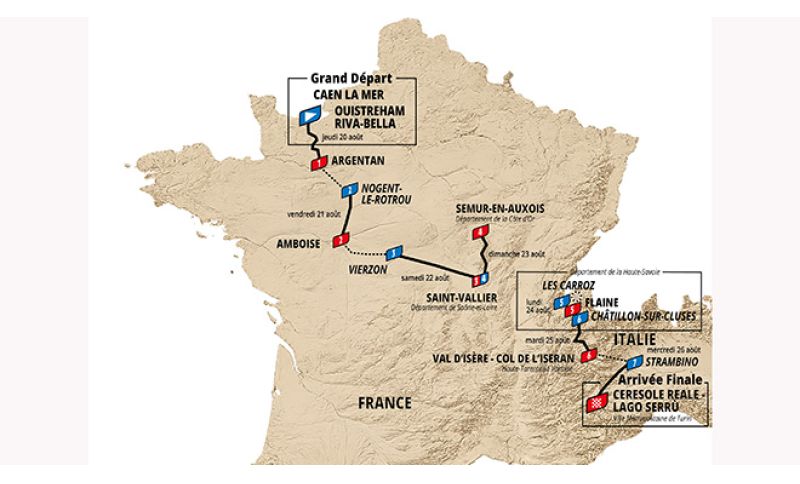
The 2026 Tour de l’Avenir will depart from the Normandy coast, undertaking a long route to reach the Alps passing through Argentan (Orne), the Perche region (Nogent-le-Rotrou), the Loire Valley (Amboise), Sologne (Vierzon) and finally Burgundy, with the now customary finish at Saint-Vallier and Semur-en-Auxois. These two stages offer interesting opportunities for breakaway specialists on the roads of the Saône-et-Loire and Côte-d’Or departments.
As tradition dictates, an Alpine triptych will conclude the race, beginning with an individual mountain time trial between Les Carroz and Flaine in Upper Savoy, passing through the Col de Pierre Carrée, and ending on an unpaved route. On the eve of the final stage, the queen stage will conclude at the top of the Col de l'Iseran, Europe's highest paved mountain pass (2,764 m), which dominates Upper Tarentaise and has become a fixture of the race over the years. Finally, as in 2024, the Metropolitan City of Turin will ensure that the Tour de l'Avenir concludes in Italy, this time not at the top of the Col delle Finestre, but on the mountain above Ceresole Reale, where the 2019 Giro d'Italia ventured for a spectacular finale near Lago di Serru at an altitude of over 2,200 metres. In total, seven days of racing will allow the group of the world's best young riders to showcase their abilities across a wide variety of terrain.
The stages
Wednesday 19 August: Team presentation (Caen-la-Mer – Ouistreham Riva-Bella)
Thursday 20 August: Ouistreham-Riva Bella (Calvados) – Argentan (Orne): 152 km
Friday 21 August: Nogent-le-Rotrou (Eure-et-Loir) – Amboise (Indre-et-Loire): 116 km
Saturday 22 August: Vierzon (Cher) – Saint-Vallier (Saône-et-Loire): 232 km
Sunday 23 August: Saint-Vallier (Saône-et-Loire) – Semur-en-Auxois (Côte-d'Or): 131 km
Monday 24 August: Les Carroz – Flaine (Upper Savoy): Individual time trial: 16 km (760 m elevation gain)
Tuesday 25 August: Châtillon-sur-Cluses (Upper Savoy) – Val d'Isère, Col de l'Iseran (Upper Tarentaise, Savoy): 149 km (4,945 m elevation gain)
Wednesday 26 August: Strambino (Metropolitan City of Turin) – Ceresole Reale Lago Serru: 130 km (2,556 m elevation gain)
Total: 926 km / 13,316 m elevation gain





 Ritratti
 Oscar
Oscar Albi d'Oro


Se sei giá nostro utente esegui il login altrimenti registrati.