
















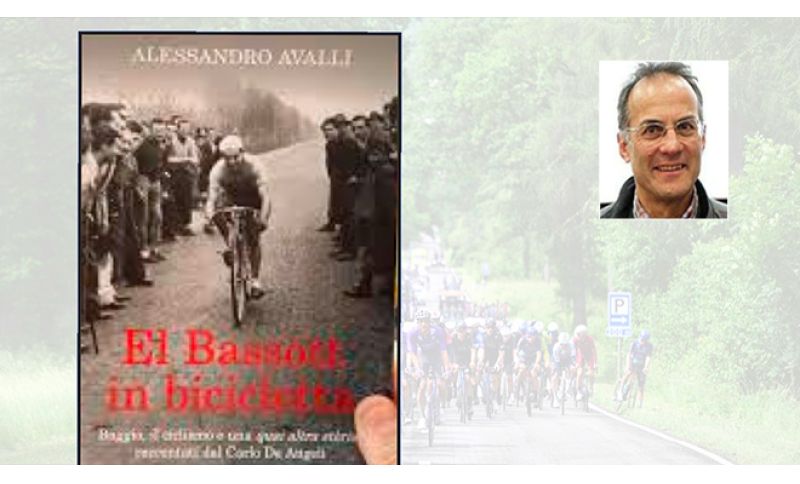
El Bassott, because height was not his strong suit. Or Napulìn, because his complexion was that dark southern tone. Or Gazzusatt, because he was a boy distributing soft drinks and mineral water to bars and restaurants. Or Cadèna, in the sense of the chain, the weak point of his bicycle. Or more officially De Angeli Carlo – surname first and then name, otherwise what's the point of a registry? – only son of De Angeli Pietro and Magistrelli Ernesta, from Villaggio Cavour, place of birth, or from Baggio, place of life, a life on the road, a life on a bicycle. "El Bassott in bicicletta", the title of a book that intrigued me, delighted me, accompanied me, moved me, confused me, captivated me.
Alessandro Avalli wrote it, a Milanese from those parts, the western outskirts, he published it Alessandro Avalli, still him, who by trade writes and produces and by passion runs and pedals, and he distributed and spread it Alessandro Avalli, always him, who in the "cultural work" industry (copyright Luciano Bianciardi) fights and perhaps sometimes struggles, and you can understand why, when bookstore shelves are filled with much else but bland or fried fare. The release date goes back to November 26, 2024, but there's no rush, because there will always be time, for a story that runs, navigates, pedals through time.
El Bassott will never be a champion, but almost. His first bike is a Magistrelli (all bikes are feminine in gender, at least in speech), a cycle mechanic from Cisliano. When the De Angeli family moves to Baggio, El Bassott migrates from bike to bike, because this was the paradise of frame builders and mechanics, therefore of races and riders, therefore of teams and stories. Two rooms plus kitchen and even a bathroom at number Eighty-two, via Alessandro Scanini 82, a building with three staircases, three floors for each staircase, two small apartments for each floor, and a horde of children who sniff around, who sparkle, who are dying to live.
El Bassott tells his Baggio, between bowling clubs and dance halls, between the new church and the old church, between the bell tower and the organ, between the gamba de lègn (tram) and the spicciole (bikes), between Coppi (on the radio) and Zanazzi (at the starting line: "Watch out, guys, here comes Zanazz"), because here all names and all surnames are always preceded by the definite article (never mind if it's grammatically incorrect). The center of the world is that of the wheel: races as adventures and misadventures, as declarations of belonging and certificates of identity, as acts of courage and pacts of alliance, well knowing that complicity rhymes with rivalry and that in a breakaway there's always something of subterfuge, races above all as a way to be in the world, and to learn how to be in the world. All those times when a breakaway companion declares himself dead tired and begs to be brought to the finish, then miraculously finds his strength again, can't resist temptation, launches a sprint and wins.
The cyclists, in the sense of riders, what a zoo: the terrible and diabolical Zanazzi brothers, Renzo, Valeriano called Iano and Mario, Carlo Pozzi, track rider and ice cream maker, Cavallini, first of the isolated ones in a Giro d'Italia dominated by Binda, Ernesto Colnago, who already then knows how to play ahead of time, Luigi Ferrando, three times Italian cyclocross champion, Colombo, who in a sprint crashes first against a spectator then to the ground and never gets up again, Carlo Galletti, passed into history missing an 'l' (Galetti), as well as three times winner at the Giro d'Italia, Virginio Dossena, called El Verza… And then the cyclists, in the sense of mechanics and frame builders, what a university: doctors, surgeons, magicians if not prophets of bikes, from Paletti to Gramaglia, from Carlo Monti to Pep Magni. Here, in this way and in this world, Luca Guercilena also grew up, and so now so many things make sense, the main one being humanity.
Alessandro Avalli must be proud of this book of his. He composed it by listening, translating and not betraying. He wrote it in Italian and in Milanese, by ear and nose, with his head and heart. He finally made himself smaller to enter the Bassott and exit with two affectionate final lines: "That time I won a Monti for leisurely riding at the lottery, I left even happier. I used it until yesterday".

 1
1


 1
1


 5
5
3
3
5
5
3
3

 Ritratti
 Oscar
Oscar Albi d'Oro

