



















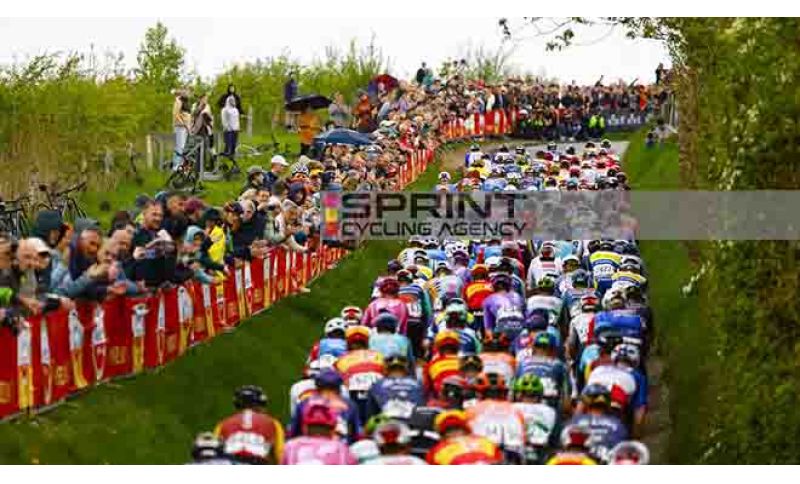
The Amstel Gold Race 2026 offers a particularly useful case study for understanding the transformation of contemporary cycling. The Dutch race retains all the attributes of a great classic: membership in the WorldTour calendar, 257.2 kilometers, 3,400 meters of elevation gain, departure from Maastricht, finish in Valkenburg, one of Europe's most passionate crowds and a strategic position at the opening of the Ardennes triptych.
However, the "quality of starters" measured by the scoring of athletes in the international ranking stands at "only" 668: it signals a significant reduction in competitive density compared to its recent tradition. The data should be read with caution, but also with rigor. Some of our recent studies measure the quality of riders based on their position in the UCI ranking at the time of departure: the more riders placed in the upper tiers of the ranking, the higher the score assigned to the race. This is therefore not an aesthetic judgment, nor an evaluation of historical prestige, but a synthetic indicator of the actual concentration of competitive value at the start.
The first finding is that there is no generalized crisis in the WorldTour. Some races maintain or increase their competitive strength: Milan-San Remo stands at 1072, Tirreno-Adriatico at 931, Volta a Catalunya at 821, Paris-Roubaix at 794 and Gent-Wevelgem at 790. Others, however, show a more marked decline: Amstel, Paris-Nice, E3 Saxo Classic, UAE Tour and Ronde Van Brugge. The ranking developed by our study for rider quality "at the start" confirms this uneven distribution of values.
The Amstel case is emblematic because it shows a clear divergence between institutional attractiveness and competitive attractiveness. The race remains fully WorldTour, popular, recognizable, technically selective; but in 2026 it does not present the same concentration of top-level talent as in its best years. Our analysis attributed 954 points to Amstel in 2025, 884 in 2024, 1089 in 2021, 1041 in 2019, 1162 in 2018 and 1129 in 2016. The 2026 value of 668 is therefore significantly lower not only than the last edition, but also than the average of the recent decade.
The same dynamic is observed, with even greater intensity, at Paris-Nice: 659 points in 2026 compared to 868 in 2025, 957 in 2024, 981 in 2023 and 1182 in 2022. The E3 Saxo Classic also drops to 526 points, after recent values of 691 in 2025, 734 in 2024 and 853 in 2023. We are not, therefore, facing an indiscriminate loss of prestige, but rather a selective polarization: some races still absorb the great attractions of world cycling, while others suffer from the more scientific programming of leaders and teams.
Contemporary cycling is not less competitive; it is more rational, more planned, more dependent on peak form management. Top-level riders no longer chase every prestigious race: they select blocks of performance, primary objectives, recovery windows, and trajectories suited to the Monuments, Grand Tours or championships. In this new arrangement, the history of a race remains fundamental, but no longer guarantees the presence of the best riders.
The conclusion is therefore clear: the value of great races does not disappear, but changes in nature. Institutional attractiveness remains linked to tradition, calendar, public and category; competitive attractiveness, on the other hand, depends on the actual density of top-level riders. The Amstel Gold Race 2026 tells precisely this transition: a classic still monumental in cycling culture, but less dense in competitive composition. The future of cycling will increasingly be played out in this space: not only on climbs, in the wind or on narrow roads, but on the strategic choices of riders, who have now become the true regulators of the competitive geography of the world calendar.

 10
10


 10
10


 4
4
5
5
6
6
4
4
4
4
5
5
6
6
4
4

 Ritratti
 Oscar
Oscar Albi d'Oro

