
























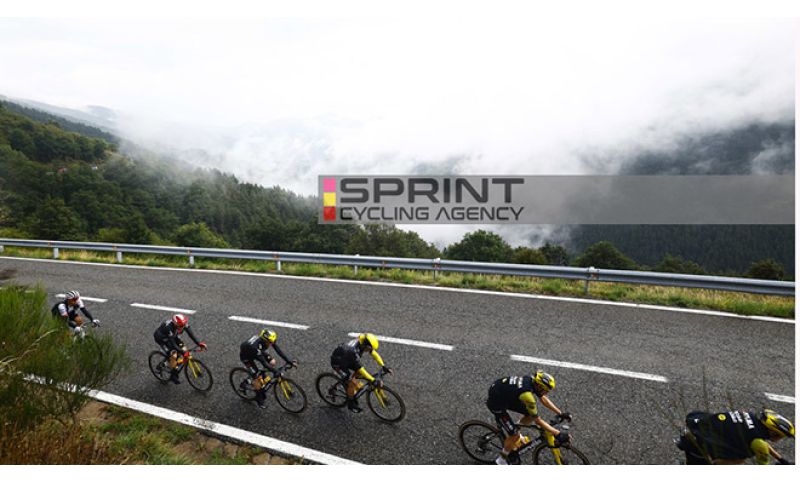
Handlebars, wildcards, time trial helmets, calendar, gears. From January 1st, several modifications to the UCI technical regulations have come into force, which might seem insignificant from the outside, but are already causing a stir and discussion in the peloton.
1. Minimum handlebar width of 40 centimeters
In recent years, to pursue maximum aerodynamics by forcing riders to keep their shoulders narrow, handlebars have become increasingly narrower. But this position, while making the rider faster, does not allow optimal bike control. Therefore, the UCI has imposed that the minimum handlebar width will be 40 centimeters, measured between the two outermost points. To prevent riders from tilting brake levers far outward to circumvent the rule, the UCI has also limited the angle of the brake levers. The issue of women's cycling remains. AG Insurance-Soudal's sports director, Fien Delbaere, stated: "For WorldTour teams in women's cycling, the standard handlebar width is between 36 and 38 cm". Lieselot Decroix, performance manager at FDJ-Suez, added: "Apparently, female anatomy was not taken into consideration".
2. Wildcards only for teams among the top thirty in the UCI ranking.
The invitation or non-invitation of teams to Giro, Tour, and Vuelta has long been a monopoly of organizers, but the UCI is increasingly regulating the wildcard system. From January 1st, organizers of the three grand tours must invite the top three ProTeams in the team ranking, instead of the top two. And only teams among the top thirty of such ranking (considering the 2025 ranking) are admitted to have a wildcard, up to the maximum number of teams at the start. This is a problem affecting Italian ProTeams - currently Polti VisitMalta is 28th, Bardiani CSF 7 saber is 30th, Siolution Tech Noppo Rali is 31st, while MBH Bank CSB Telecom Fort is obviously further back as it debuts in the category) who fear losing their invitation to the Giro d'Italia, the salvation of their season. Roberto Reverberi, Bardiani-Csf team manager, explained: "This forces you to race incorrectly, even tactically: not focusing on the overall victory, but on ranking and points. Points are unfair and poorly distributed: winning a 2.2 race in Asia is more important than a stage of Coppi e Bartali".
3. Prohibition of time trial helmets in road stages
It was one of the most extraordinary images of Volta Algarve: Wout van Aert presenting himself at the start of a stage wearing... a time trial helmet. "Several wind tunnel tests have shown that the time trial helmet is significantly faster than a standard one," explained his former teammate Nathan Van Hooydonck. Wearing a time trial helmet in road stages quickly became a trend, but the UCI has said enough: from January 1st, it is forbidden. To differentiate time trial helmets from traditional ones, the UCI has set some criteria: a helmet for a road stage must have at least three air vents, an integrated visor is not allowed, and the helmet must fit in a box measuring 450 × 300 × 210 millimeters.
4. Calendar: Tour de Suisse reduces from eight to five days.
In the new UCI calendar, some race names are changing: Gand-Wevelgem is now called In Flanders Fields (from Middelkerke to Wevelgem) and the Dauphiné becomes Tour Auvergne–Rhône-Alpes. But the most surprising change is that the Tour de Suisse is reduced from eight to five days. Consider that the Swiss race, in its golden period, had up to eleven stages. Now organizers support the compact format, designed to ensure a certain future for the race. Moreover, in 2026, men's and women's races will completely overlap. UCI President David Lappartient had imagined 2026 as a year of major changes: no overlap between Paris-Nice and Tirreno-Adriatico and to "adapt to climate change" some spring classics were hypothesized to be moved to autumn. None of this will happen.
5. No limit to the maximum number of gears
There was extensive discussion about the UCI wanting to curb gear exaggeration by setting a maximum number of teeth for the front chainring. In particular, the UCI wanted to introduce 54x11 as the longest gear, developing 10.46 meters per pedal stroke. The reason? Excessively long gears allow very high speeds and can therefore cause falls. The Belgian Competition Authority (BCA) blocked the initiative because this measure would exclude the 54x10 combination from the American manufacturer Sram and thus limit competition. Lidl-Trek and Visma-Lease a Bike, for example, use the popular Sram Red AXS group. The Belgian court sided with the American manufacturer's appeal, so in 2026 there will be no limitation on monster gears.

 12
12


 12
12


 7
7
4
4
2
2
2
2
2
2
42
42
3
3
7
7
4
4
2
2
2
2
2
2
42
42
3
3

 Ritratti
 Oscar
Oscar Albi d'Oro

