














These days, there's much discussion about whether cycling should or could become a paid sport, like almost all others. The romantic fan abhors the idea: cycling is of the people, it has always been free and must remain so. On the other hand, however, putting oneself in an organizer's shoes immediately reveals that a race is not sustainable unless you're called Tour de France or Giro d'Italia. This was also said a few months ago by Pierre-Yves Thouault, Tour's deputy director: "ASO only earns money from the Tour and races contracted in the Middle East (AlUla Tour and Tour of Oman, ed.)". Even a historic and fascinating event like Paris-Nice, for example, is born with the awareness of not having an economic return equal to its costs.
The fortune of Italian - and European in general - cycling is that passionate organizers and sponsors still exist who continue to invest. But costs are rising for everyone, and it's normal to seek innovative solutions to put some hay in the barn and not do everything at a loss. Filippo Pozzato, with the Ride the Dreamland project, Tisa Party and VIP experiences, has been pushing this idea for years - even though the debate has only heated up this autumn - and it's surprising that he's practically the only one wanting to earn something by organizing races. "If the race passes in front of my house, do I have to pay a ticket?" is the question that circulated on social media. Obviously no: cycling is and will remain free. But setting up reserved and comfortable, paid areas at crucial points of the route seems legitimate if you put yourself in the shoes of someone who struggles for months to make everything work. Then it's up to the organizer to position them in the right spots, preferably in a circuit to allow multiple passages, equip them well and above all attract the big stars for whom it's worth opening one's wallet.
In Flanders, this is already done with great success: everything sells out in a few days, both for road races (tickets from €130 up to VIP experiences over €4000) and for side events. And in the Grand Tours, in the form of hospitality, the same happens. A part of the finish straight of each Giro stage hosts areas reserved for invited guests, mostly sponsors, but accessible to everyone by purchasing packages from tour operators present on the site.
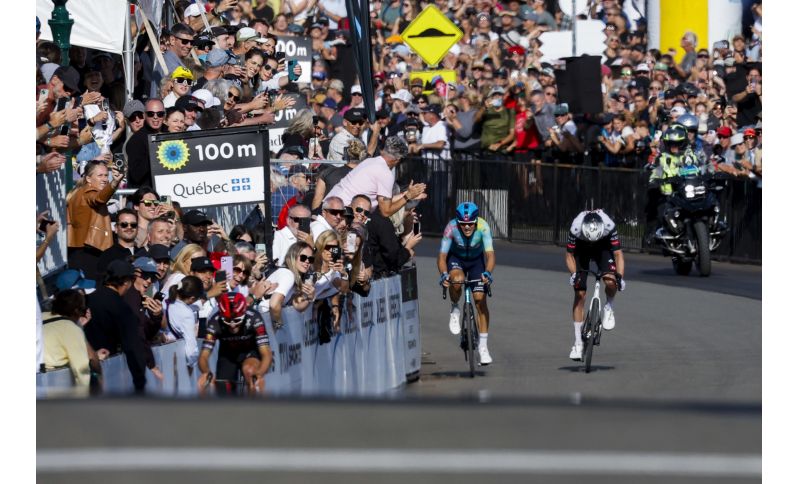
Another example comes from Canada: the Grand Prix Cyclistes of Québec and Montréal, which we were fortunate to see up close last September. These are races born in 2010, without the history of the Tour of Flanders, but capable of creating a winning model. It's true, every year they bring riders like Tadej Pogačar and Wout Van Aert - and this helps - but they still manage to involve about 250,000 people. The entire circuit (to be repeated between 15 and 18 times) is free, except for a part of the final straight reserved for those who purchase the VIP pass. It costs 500 dollars (about €300) and includes a buffet with a view of the finish and two car rides behind the group or the breakaway. There were 1000 spots for Québec and 1000 for Montréal, all sold out. This means that the organizers, thanks to enthusiasts, collected a million dollars (over €600,000). In Italy, with that amount, you can organize two or three high-level classics.
Naturally, we're talking about countries - Belgium and Canada - with cultures different from ours: the former have cycling in their blood, the latter are more inclined to experience a new event as a big show. "The Netflix series on the Tour de France has given an enormous boost here: people are willing to pay just to see it," they told us. In Italy, fortunately, Netflix is not needed to understand the charm of this sport.
That said, we consider it unfair to demonize those who try to earn money by organizing cycling races. If the quality of the event increases, we all benefit: organizers, fans, and media. And giving a hand by paying a ticket of 10-15€ to enjoy the race in a less spartan way - money that, upon reflection, serves more to sweeten the pill for organizers than to repay the event - cannot be considered scandalous. 99% of the route would remain free and open, and everyone could freely choose how to experience the race. As it has always been.

 15
15


 15
15


 3
3
5
5
3
3
1
1
3
3
5
5
3
3
1
1

 Ritratti
 Oscar
Oscar Albi d'Oro

