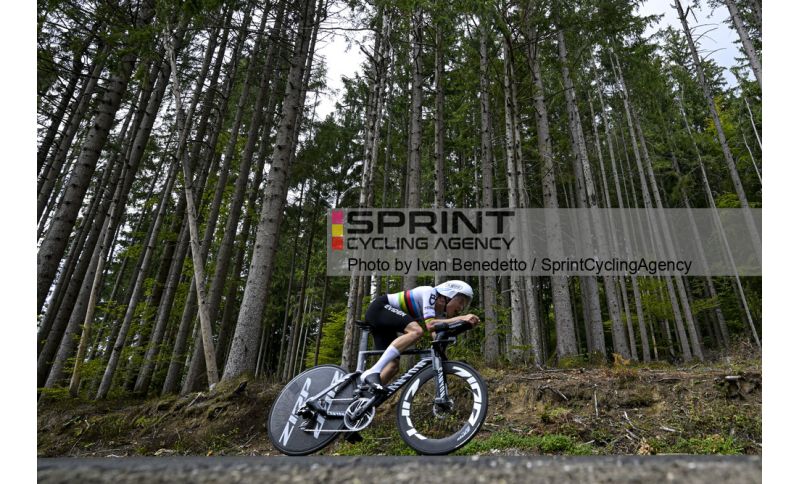
From the assessment of her 2026 sporting season, to an evaluation of the state of women's cycling, through to the issue of gender equality: Marlen Reusser, world and European time trial champion, winner of the Tour de Suisse and Dwars door Vlaanderen, addressed these and other topics in a lengthy interview with Domestique. Below are the key passages.
THE 2026 SEASON AND THE "HEART DIVIDED IN TWO" «Speaking about my year, my heart is divided in half. I have to deal with conflicting feelings. On one hand, I'm proud of what I've achieved, but on the other, I'm still very sad thinking that I came very close to important victories that slipped away from me. For example, I think differently about what happened at the Road Worlds compared to how the Tour de France went».
THE DIFFICULTIES AFTER THE TOUR «The Tour tested me hard, even emotionally. It wasn't easy to accept how it ended, I had to switch off a bit and I think I didn't arrive at the Worlds in peak form. It was my mistake, but I needed it. I went to Canada quite early before the races, but during that time I really had fun, I spent beautiful days in a house we rented in the middle of nature. But it was a beautiful period on a human level»
THE ROAD WORLDS IN CANADA. «I'm not entirely sure what happened in the road race in Montreal (finished fourth, ed.), I lost the moment. I certainly had some problems, especially with refueling, but the most important thing is that at the decisive moment I wasn't focused; when I realized it, I tried to recover thinking I could still make it. I went all out to catch up with Demi but it wasn't enough. I have to be honest, I didn't understand some tactical choices by my teammates, but I'm less upset about the Road Worlds result than about other things this season».
THE MOTIVATION TO STAY AT THE TOP LEVEL. «When I hear young people talk about motivations, they say they love training and do it with the goal of becoming a Professional. However, I believe it's not easy to understand what your real personal motivations are and which ones are induced by the social environment you live in. I'm 35 years old and, since I was a teenager, I've been trying to understand what my true motivation is for doing this sport. Even today I'm unable to fully understand what drives me to keep pedaling. There are moments when it's really tough and I ask myself why I do it, and others when everything is clear and all I want to do is ride my bike. In any case, I feel very fortunate, I'm living a truly privileged life where I can make the decisions I want: how to train, where to do it and when to do it. I like to study, to inform myself to try to understand how to improve to achieve the results my team asks of me. Furthermore, I'm fortunate that my partner is also my coach. I like this freedom, I love this life. An intense life that strengthens me».
NOT JUST TIME TRIALS. «I don't really like it when people introduce me only as a time trial specialist. Of course, time trials are the ones that have given me the most satisfaction, I'm very happy to have won two World Championships in my specialty and five continental titles. But I've always tried to prove to myself and to the world that I'm a great athlete in road races too. Think about the results I got when I was racing for Alé BTC Ljubljana (Tour of Norway, Simac Tour, Madrid Challenge La Vuelta, ed.). Time trial victories are beautiful, but my real ambition, what I train hard for, are some road races that I would like to win»
THE CRITICISM. «I believe one of the beautiful things about sport is debate. I perfectly understand those who, watching races on television, say "Attack, do this, do that". I do it too when watching or thinking back on my races. Discussing tactics, races or what could have been is nice, ours is a complex sport, debate is welcome. Personally I don't follow people's comments much, but if opinions about races turn into personal attacks, I don't accept that. Fortunately I'm surrounded by prepared people: with my Sports Director and with the Movistar staff we discuss a lot after races to understand what to improve. Besides, I care little about it».
THE NAMES OF RACES AND GENDER EQUALITY AND SPONSORSHIPS. «Cycling is a very ancient sport and for a long time women weren't even allowed to practice it. For years cycling was told mainly through a male lens. When people heard the word cycling, they immediately thought only of men's races. That's wrong, we need to change, not do things just because tradition wants it that way. Take, for example, the Tour, which deserves credit for making a big change, but when people talk about the Tour de France, many think only of the men's race. I hope that very soon it won't be like that anymore, that there's just the Tour: I don't want to be a decoration for men's sport. Think about it, it doesn't happen that way in MTB, Cyclocross or even athletics. The UCI should decide to prohibit adding "Femmes Women" to the names of races. I have another idea, something I would really like: what if companies that invest in men's cycling also helped women's cycling? If I could decide, I would say: "We've achieved great results, let's continue with men's cycling at this level and invest a percentage of what's left in a women's team". Movistar and Lidl Trek are examples to follow. Women's cycling has important value. Many companies are beginning to realize this»






 1
 1

















 Ritratti
 Oscar
 Albi d'Oro


Se sei giá nostro utente esegui il login altrimenti registrati.