

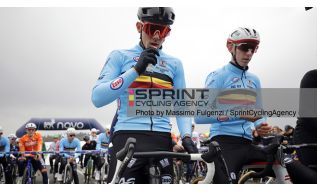





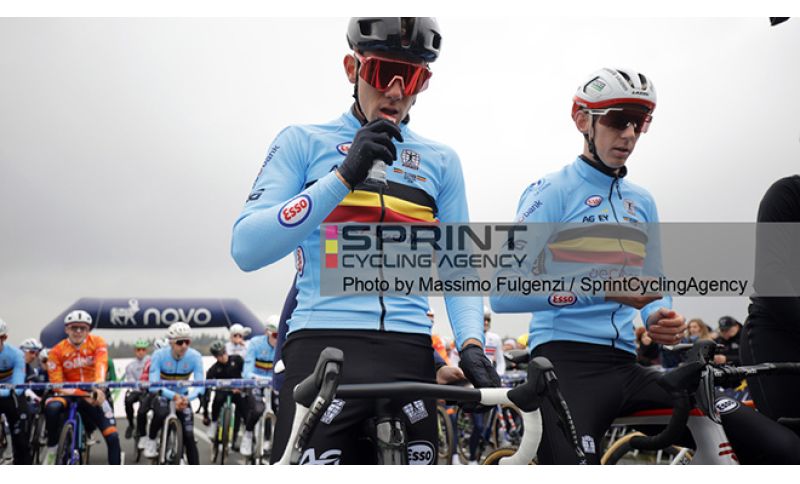
Belgium confirms itself, also for the 2026 season, as the most "decorated" nation in international cycling: eight podiums in one fell swoop at the European Cyclocross Championships in Zeddam brought the overall tally of major competitions for the year to the same record level reached two years ago. Explaining the numbers and context is Arne Wallays, director of the High-Performance department of Belgian Cycling, who, while appreciating the harvest, does not hide the need to look beyond the enthusiasm.
The official count of Belgian medals in the main international championships - World Championships and European Championships, in all disciplines (road, track, cyclocross, mountain bike, BMX and gravel) and in all categories, from elite to juniors - reads twelve golds, sixteen silvers and thirty bronzes, for a total of 58 medals in 2026. This is a figure that equals the peak of 2024 in the same types of competitions and which, according to Wallays, «is certainly impressive. We always welcome medals: the more there are, the better because they provide an indication of the effectiveness of our high-performance department. But nothing more: we are aware that, to a certain extent, we remain dependent on the talent at our disposal».
The role of elite champions was decisive: Remco Evenepoel, Wout van Aert, Lotte Kopecky and Thibau Nys represented the pillars of national success. Evenepoel, Kopecky and Nys brought home seven of the twelve world and European titles conquered by the Belgian national team in the season, contributing significantly to the overall tally. Wallays observes how, especially among young riders, the presence of "supertalents" can shift the overall count upward regardless of the training methods alone.
However, the picture also contains warning signs. The comparison with 2024, an Olympic year in which the value of medals was amplified by participation in the Games, shows structural differences: in 2026 Belgium obtained many more bronze medals (30) compared to golds and silvers combined (28), seven more than two years earlier. «Indeed, it is a striking figure», admits Wallays: at youth level the circulation of talent can explain this prevalence of third places, but the transition to victories in the elite category remains the objective.
The critical areas concern specific disciplines: mountain bike, BMX and some track time trials remain disciplines in which Belgium is less competitive at the highest levels. «On one hand we face extraordinary talents from other nations, such as Jonathan Milan and Filippo Ganna; on the other hand with countries that concentrate intensively on certain disciplines, like Australia and Great Britain, less conditioned by our dominant road cycling culture», explains Wallays. Team pursuit and combined track events remain points of strength, especially in the Six Days tradition.
To better frame and evaluate performance, Belgian Cycling uses an internal classification system that assigns different weight to medals and separates elite results from youth results, World and European Championships. Wallays emphasizes how year-on-year comparisons can be misleading: «At the moment we are at 143», a value lower than the 182 of 2024 but to be interpreted in light of the weight of Olympic medals and the different consistency of the competitive calendar.
Economic management and athlete support have been revised: the prize system for World and European Championships has been reformed and funding is no longer paid directly to riders; the savings have been partially reallocated to the operational budget for staff and technical guidance. Wallays defends the compromise reached and does not intend to go back: the high cost of Olympic qualification, with many races outside Europe, imposes careful choices.
With eyes already turned to Los Angeles 2028, Belgian federation strategy remains twofold: consolidate strengths (road, cyclocross, some track specialties) and progressively improve where the medal is today an out-of-reach objective, such as in mountain bike and BMX. «Cyclocross unfortunately is not yet an Olympic sport, but we can continue to consolidate the progress made in road and track cycling», observes Wallays, recalling that the concrete possibility of achieving important results in Los Angeles will be the fundamental condition for defining investment and qualification plans.
Therefore, it is possible to say that Belgium's 2026 balance sheet has confirmed the country's ability to convert talent and tradition into international results. But, as the High-Performance director reminds us, more than celebrations and titles, what is needed is analysis, targeted adjustments and a long-term project that transforms today's bronzes and silvers into increasingly consistent elite golds.






 |
 |
||
 |
 |
|
|
 |
|
||



 Ritratti
 Oscar
 Albi d'Oro


Se sei giá nostro utente esegui il login altrimenti registrati.