





















The bicycle is a meeting of souls. In the peloton you can find those hungry for victory, those who work for the captain without asking for anything, domestiques who consume their legs and dreams for a "well done" said at the end. And then there are the poets of suffering, those who manage to transform a climb into a story to tell for a lifetime.
They are all different, yet they belong to the same family. Because in cycling there is a solidarity capable of erasing distances. Those who have raced remain young within their passion, even when the bicycle becomes a memory.
In the peloton cyclists have no age. Gigi was 25 years old when, on May 31st, 1963, he faced the Gran San Bernardo at the Giro d'Italia wearing number 36 for Gazzola. That day he attacked. He wanted to look those forty kilometers of climbing in the face, before anyone else.
Nino Rota, in the Gazzetta dello Sport the next day, described that tremendous stage like this: "At Sierre the gathering had not been as festive as usual. Despite the sun, the colors of the sky and mountains and the joy spreading to the sound of fifes and drums from the austere Valais band. Everyone was thinking about the great mountain; the riders about its merciless harshness, the entourage about avalanches and landslides..."
And then Gigi ahead: "In any case, Gigi Mele immediately took off with Ranucci, Galdeano, Fornoni and Conterno."
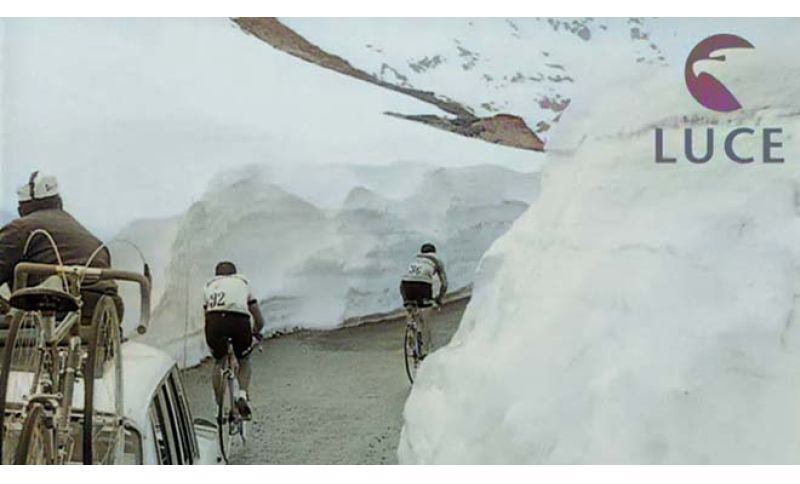
The photograph you see tells exactly that moment. Gigi is four kilometers from the summit of Gran San Bernardo, captured by Diego Ronchini, who had lost the pink jersey the day before, pedaling inside a corridor carved through the snow, squeezed between two immense white columns. It is a photograph that seems almost impossible. But it is real. And you only need to look at it to understand cycling from those years.
Rota spoke of riders struggling in the snow, of violet-colored hands, of newspaper sheets distributed to protect the chest and of men who, before grasping the handlebars again on the descent, made the sign of the cross.
Then that mad descent: "Remember the Stukas in a dive? The speedometer could even exaggerate but you were definitely traveling between seventy-five and eighty kilometers per hour. They were all cannonballs! You could see them very well from the balconies now cleared of snow. And down there, announced by the smoke from the chimneys, beautiful Aosta. Twenty-eight kilometers to the finish".
Gigi arrived at Saint Vincent in seventeenth place, in the group of Italo Zilioli, four minutes behind winner Taccone. But that day it was courage that delivered him to memory. Years later he would tell me that when Taccone, Balmamion and Adorni passed him, that gust of champions was so violent that he almost went over the cliff.
This is cycling. It puts you face to face with fear and still asks you to keep pedaling. Because those who learn to stay in the saddle carry that lesson outside of races too: facing climbs, respecting those ahead of you, not forgetting those who come behind.
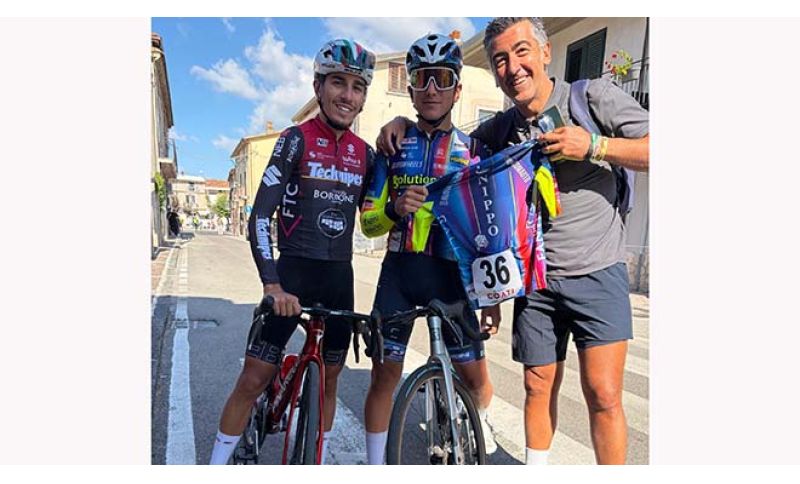
Sixty-three years later, another young man, Michele Pascarella, born in 2007, presented himself at the start of the revived Giro di Campania. From Maddaloni, like Alberto Marzaioli, who was Gigi's teammate in the peloton and before that a friend. And on his shoulders he wore number 36. The same number as Gigi.
Seventy years divide those two young men. The bicycle, instead, makes them the same age. They had the same crazy idea: become professional cyclists. The same desire to test themselves against the road. The same fire before a start.
Then came the surprise. One Sunday, while on those roads young riders, juniors and youth categories were racing, Michele arrived on a training ride with Ivan Toselli. Biagio and Carla, his parents, had anticipated it to me without telling me everything. Michele reached me.
And he handed me his Giro di Campania jersey. The one with the 36. Michele has the hunger of someone who wants to race, but also a rare sensitivity for his age: he understood that that number was not just his race number. It was a family story, a piece of the road traveled by Gigi, and he chose to give it to me so that story could continue.
I took it in my hands and thought that certain numbers don't belong only to those who wore them. They become a thread. A story that passes from one back to another.
And I am almost certain that Gigi, starting to ride again with Michele, has already begun to do what old riders do when they recognize their own story in a young man's eyes. He will have told him to try.
Not to be afraid.
To attack when he feels it's the moment.
And above all not to look back when he attacks.
I, instead, think of the boy from 1963 who raced toward Saint Vincent with the 36 on his shoulders. And the boy from 2007 who today wears the same number. Gigi's 36 is now on Michele's shoulders. And the race, finally, can continue.



 10
10
 10
10

 Ritratti
 Oscar
Oscar Albi d'Oro


Se sei giá nostro utente esegui il login altrimenti registrati.