





















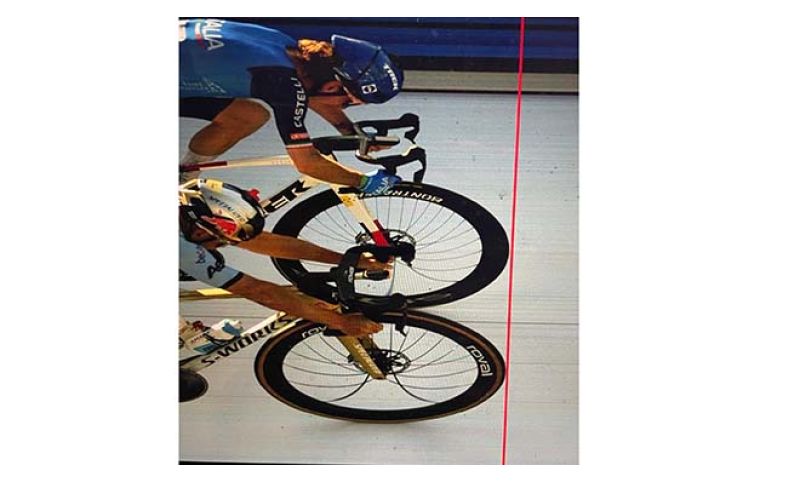
The photo finish from Sencur is destined to go down in history. After having explained to you in simple terms how it works, in light of the doubts raised by Giulio Ciccone, we asked EvoData to go into detail and clarify how it determined the victory by a matter of millimeters last Sunday at the European road cycling championships. It was such a close finish that it seemed almost like an illusion: in the end, Remco Evenepoel raised his arms to the sky as the winner, while Giulio Ciccone asked to review the photo finish images because it's difficult to accept a defeat decided by just a few millimeters. That "little" was instead quantifiable, and it's the perfect demonstration of how, in modern sport, the boundary between triumph and defeat sometimes passes through a single line of pixels.
The photo finish is not a simple instant photograph: it's an optical timing and capture system built to reduce human error to a minimum. EvoData, the company that managed the photo finish for the race in question, uses a linear scanning camera (EtherLynx Vision PRO). As explained by Paolo Orestilli, co-founder of EvoData, the camera doesn't take conventional 2D images but rather "scans" a strip just one pixel wide that runs exactly along the finish line, continuously acquiring it over time. The vertical portions captured are then placed side by side: the horizontal axis of the image represents time, the vertical axis represents position on the track. The result is a time-image that allows determining with extreme precision which point of the body or bike crossed the finish line plane first.
For safety and validation reasons, two synchronized cameras are used (primary and backup), positioned at opposite angles; the primary camera used in this case captures up to 13,000 lines per second, allowing it to "freeze" the passage at very high temporal resolutions.
The transponders attached to the bikes serve for real-time detection and as a backup, but they are not the official tool for determining the finishing order in a tight sprint: UCI regulations entrust the decision to the optical photo finish. Transponder data can corroborate the times, but when the line is contested millimeter by millimeter, the linear scanning camera is the official source.
EvoData measured a time difference between Evenepoel and Ciccone of 0.0002 seconds (0.2 milliseconds). Translated into physical margin, at sprint speed, the estimated gap is between 2.8 and 3.3 millimeters. Numbers that explain why Ciccone asked for a review: accepting a defeat determined by just a few millimeters is difficult for any athlete, even more so when there's the full emotional weight of a European title at stake.
Numbers and images can be rigorous, but they don't erase the brutal nature of defeat when the margin is microscopic. Asking to review the photo finish is a natural reaction: it's the attempt to seek certainty in a moment when every detail matters. At the same time, the technical protocol, synchronized cameras, high scanning frequency, certified procedures, exists precisely to provide the most objective arbitration possible.
When victory is decided by just a few millimeters, the photo finish becomes the final judge: a combination of technology and procedures that transforms an instant into interpretable data. On Sunday, October 4, 2026, that data awarded the title to Remco Evenepoel; for Giulio Ciccone remains the regret of a finish line that, literally, slipped away from him by less than three millimeters. And ultimately, it's precisely this exactness, ruthless and definitive, that makes modern sport so exhilarating and at the same time so cruel.
THE UEC STATEMENT. The Union Européenne de Cyclisme (UEC) informs that the photo finish system used at the UEC 2026 European Road Championships (EtherLynx Vision PRO X) records the finish line thousands of times per second (13,000 in the case of the European Championship races), making it possible to determine the finishing order with extreme precision even in cases of minimal differences.
It is important to clarify that the photo finish is not a traditional photograph. The final image is composed of the chronological succession of recordings made on the finish line: for this reason, the horizontal axis represents time and not distance. This can generate apparent distortions of wheels, bicycles and riders, with no consequence on the accuracy of the result.
In cycling, the determining reference is the most advanced (tangent) part of the front wheel at the moment it reaches the finish line. At the European Championships, two independent photo finish systems were used, which provided two separate images for result verification.
The UEC will not release further statements on this matter.

 13
13


 13
13


 1
1
2
2
1
1
2
2

 Ritratti
 Oscar
Oscar Albi d'Oro

