
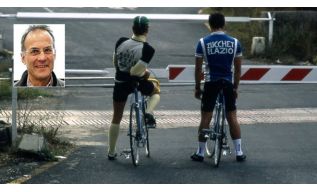















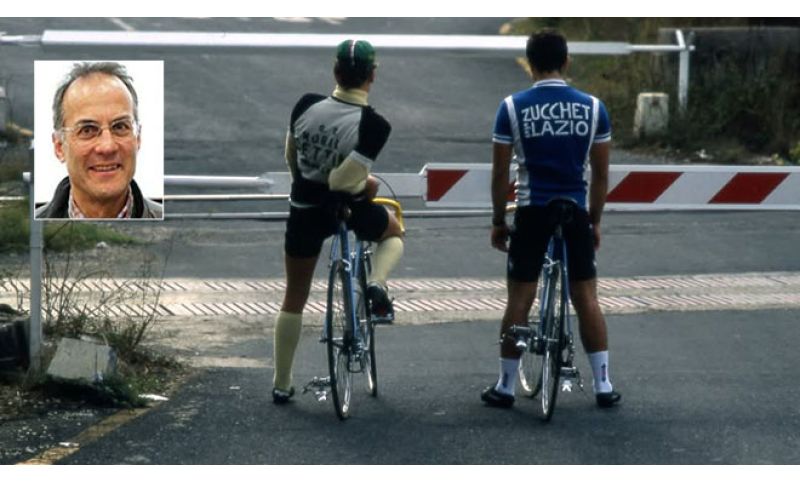

Bracciano. The railway crossing is closed, the barriers lowered, nothing to do but wait. And the two cyclists wait for the train to arrive and disappear. The cyclist on the left is sitting on the frame, his weight resting on his left leg and right elbow, wearing a team jersey over a turtleneck, unusually tall socks almost reaching his knees and a small cap. The cyclist on the right is standing with his bike between his legs, wearing the S.S. Lazio jersey sponsored by Zucchet, the pest control and disinfection company founded by Eduino Zucchet from Pordenone (he was from Fiume Veneto), a promoter and organizer of sports, an image circulates of him shaking hands with Rocky Marciano. Socrates captures the two cyclists from behind and photographs them without them even noticing. To the eye, considering the bikes and jerseys, these are the seventies.
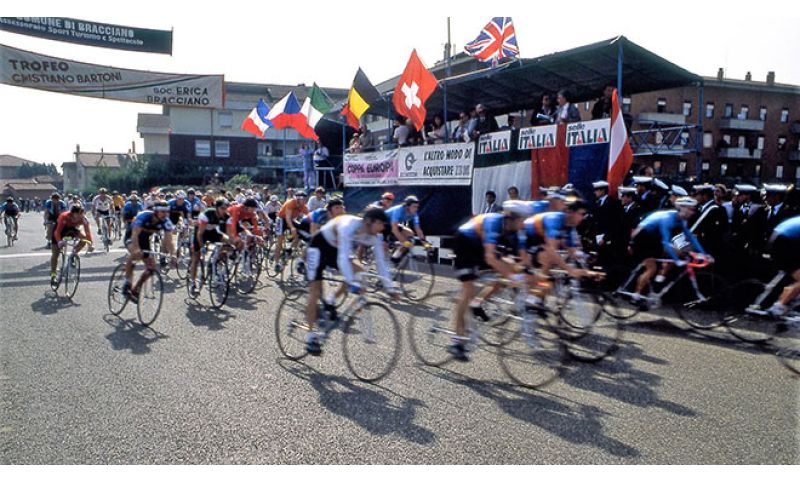
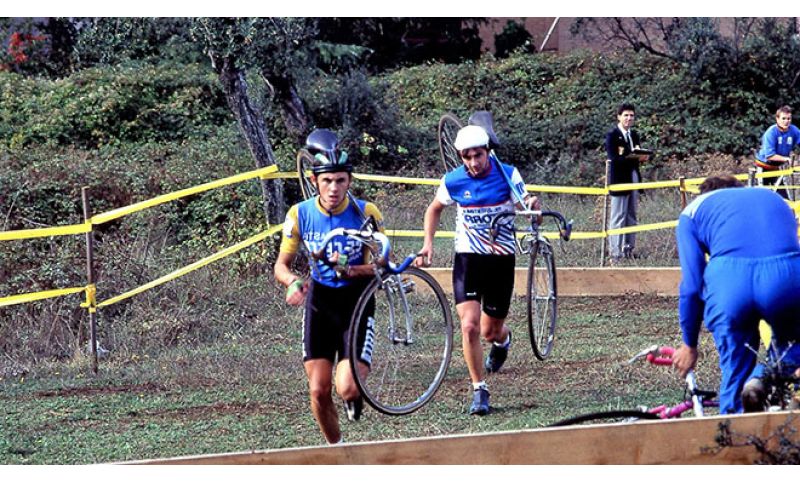
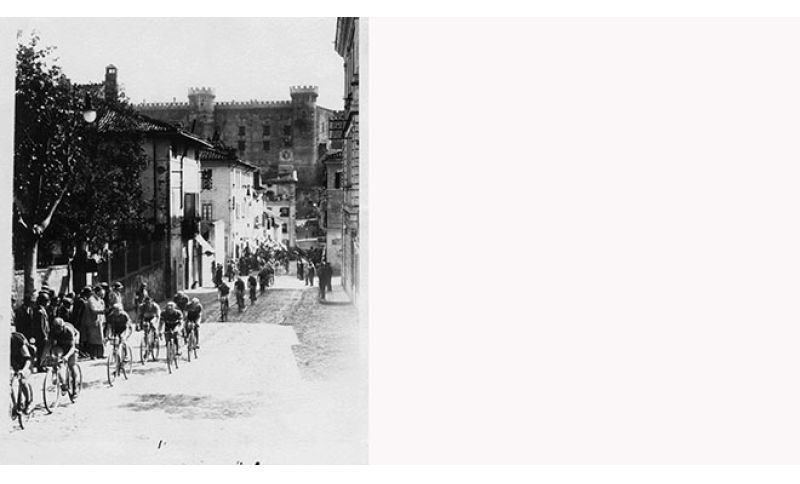
In Bracciano, Socrates has always been the photographer, not the philosopher. He still is now that he's no longer here. An agile retrospective of Socrates Pontanari's photographs will open the Slow Tourism Festival, organized by the Ti con Zero/Cammino dei Vulcani association in Bracciano from October 9th to 11th, and will be shown and discussed during a meeting in the Civic Archive that will also welcome the words of Alfredo Di Giovampaolo, journalist and author of "On the Road – Territories, People and Stories on Two Wheels" on Rai News 24, and the notes of pianist Francesco Gazzara. About fifty photos by Socrates, divided into two parts, the first dedicated to landscape, the second to people, conceived and intended as a tribute, a dedication, a contribution.
Socrates who had grown up with black and white and was then tempted by color. Socrates who first managed a bar, then a music shop, but whenever the mood struck him, he would abandon work, and ask Maria Pia, his wife (and who else?), to take care of things. Socrates for whom any excuse was good – if the sky was fleecy or rain fell in buckets, if the sun was blazing and the snow dazzling, if it was dawn or sunset, if it was a demonstration or a procession, if it was a school or an outing – then he might happen to come across two cyclists blocked by a closed railway crossing, catch them from behind, point his lens and take a photo.
Socrates who loved the Beatles and Simon & Garfunkel, who adored Ennio Morricone's film scores, who was crazy about westerns and science fiction. Socrates who allowed himself a Campari or a Negroni, who surrendered to the lake fish fillets, who melted over pan-fried sampietrini with wild fennel and a side of mixed greens with lamb's lettuce, who drove only Renaults, who didn't smoke because when he was 13 he tried a cigarette made from butts and felt so sick that he never tried again.
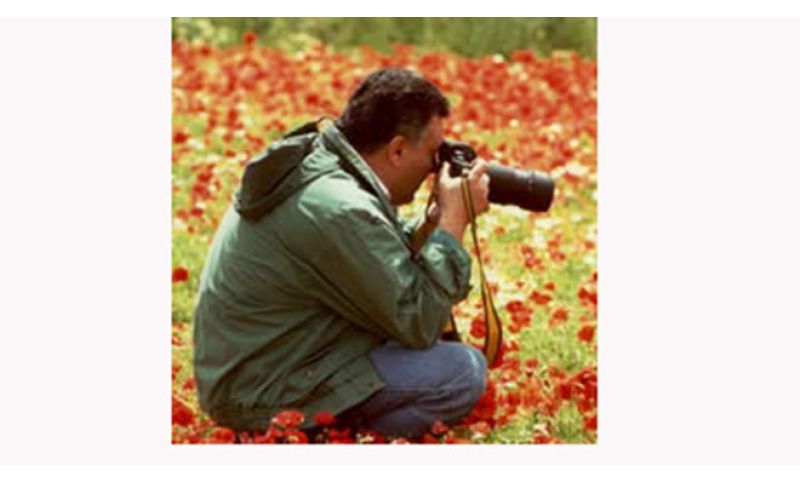
Socrates who is the photographic memory of Bracciano. Socrates who was among the founders of the Bracciano Photography and Film Association. Socrates who loaded himself with his Nikons (but also photographed with instamatic cameras and eventually with mobile phones), entrusting them even to Maria Pia, convincing her to become his assistant. And in Socrates' archive there is, of Bracciano, the history and geography, the inhabitants and protagonists, the glances and gestures. Much in black and white, but also in color. An enormous, precious, indispensable legacy today. Almost any subject could have at least one exhibition mounted from it. Two documentaries were also made about and for Bracciano. And on the tombstone in Bracciano's cemetery, Socrates is portrayed with his camera.
Two months after his death, on the day of his sixtieth wedding anniversary, a letter magically emerged that Socrates had written to his wife and children. An unexpected gift. To his children he recommended: "Always be yourselves". To his wife he confessed: "Goodbye my dear, forgive me so much if I gave you so much to do, but I needed it".




 Ritratti
 Oscar
Oscar Albi d'Oro


Se sei giá nostro utente esegui il login altrimenti registrati.