"A grand start of the Giro d'Italia? It's a dream, an objective we're pursuing, aiming to make it concrete in 2029". Even when you broaden the horizon of this pleasant conversation with Cătălin Sprinceană, president of the Romanian Cycling Federation, a man who combines an innate propensity for communication with the pragmatism of a sports director, current events bring us back to the inspiring model of the pink race.
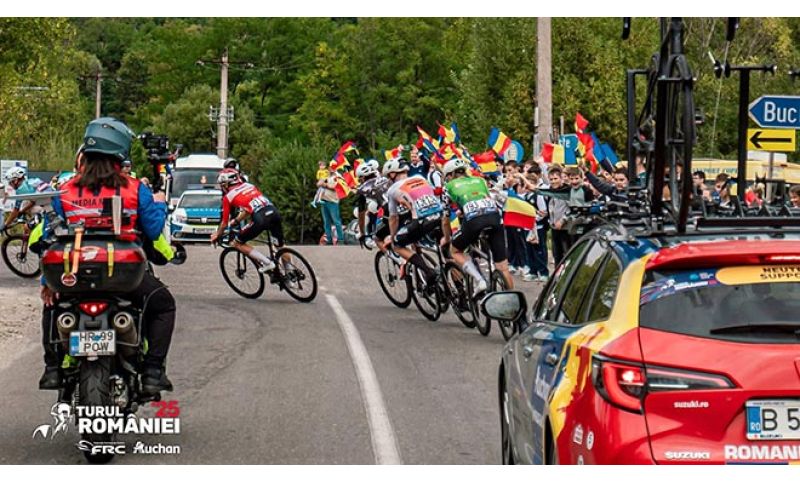
Is this the first time the Tour of Romania starts from beyond the borders?
"Indeed it is. A race with 57 editions behind it is starting from nearby Chisinau, the capital of the Republic of Moldova. It's a territory with which we share great historical, linguistic, and economic relations. It's wonderful to build a bridge through sport".
Speaking of bridges, there's the one with Italy...
"All the more reason to welcome Marino Amadori's boys among the starters. A few months ago we inaugurated a federal base in San Vito al Tagliamento, in Friuli, a facility that allows us to do targeted work on the competitive growth of Romanian riders, both men and women. That's not all: through an agreement I signed with your president Dagnoni, our national team riders will be able to participate in regional races in the youth, junior, under-23 and elite categories. Until June 7, 2028, in short, Romania's National Team won't be considered a foreign team".
Sprinceană, what is the state of health of cycling in your nation?
"We're experiencing tangible interest that ten years ago was unimaginable. I can also cite the example of the Etape du Tour de France, with 2,000 participants. As for the Federation, promoting cycling in every region is fundamental, just as the organizational experience we've gained through hosting the European cross-country championships—that's where Avondetto won gold—helps us, as does the continental youth championship in 2026. We believe strongly in side events aimed at young people and amateurs, to create cycling culture".
Can the Tour of Romania grow?
"Absolutely, given the potential and various contributions, including from the National Sports Agency. We've re-entered the race in the 2.1 class, an upgrade aimed at attracting increasingly important teams. Adding a second stage race of this caliber, after the Tour de Sibiu in early July".
Given your geographic and altimetric conformation, do you feel privileged?
"Here in Romania, truly, routes can be designed suitable for every type of rider; anyone wanting to take a cycling vacation will understand. We've paid special attention this year to involving territories that haven't hosted the race in the past. We go beyond the competitive cycling aspect; we're aware of the value of young people identifying with the race from a promotional perspective, of the tourism promotion for which cycling is an unparalleled engine, not to mention the festive character capable of generating widespread pride in those who have the privilege of hosting a stage".
What do you say about the Carpathian climbs?
"The Tour de Sibiu has established the Transfăgărăşan, an iconic road where Bernal and Finn prevailed solo. In the coming days, after the undulations of Romanian Moldova, we'll emphasize the finish at the thermal resort of Băile Balvanyos, a locality with about 2,000 meters of total elevation gain, destined to conclude along a second-category climb of 3.5 km at 4.5 percent average gradient. Nothing transcendental, to keep the predictions open. The next day features a first-category climb at the 70th kilometer of 164 km overall, although toward Ploiesti it won't be just descent or flat terrain. We expect a lot from Sunday's circuit in Bucharest, an opportunity for sprinters and an appeal for the capital's public".
Did you comment on the Giro d'Italia in Bulgaria for Eurosport with a bit of envy?
"No, rather motivated to do well, demonstrating how cycling can enter the DNA of athletes, making the most of our riders' activity abroad—that's the strategic role of San Vito al Tagliamento—as well as the experience of boys who have known professional cycling, I'm thinking of Tchetkov, who will be the selector at the Montreal Worlds, not forgetting the contribution that Eduard Grosu could provide. In recent months, Romania's political situation has been marked by a government crisis, but the contacts established with Italy and RCS lead us to be optimistic: being ready to host the pink jersey means also raising the competitive level of our movement. Thus we could fully grasp the legacy of the Giro".
Budapest, Tirana, Sofia. Bucharest advances.


















 1
1


 1
1



 Ritratti
 Oscar
Oscar Albi d'Oro

