


























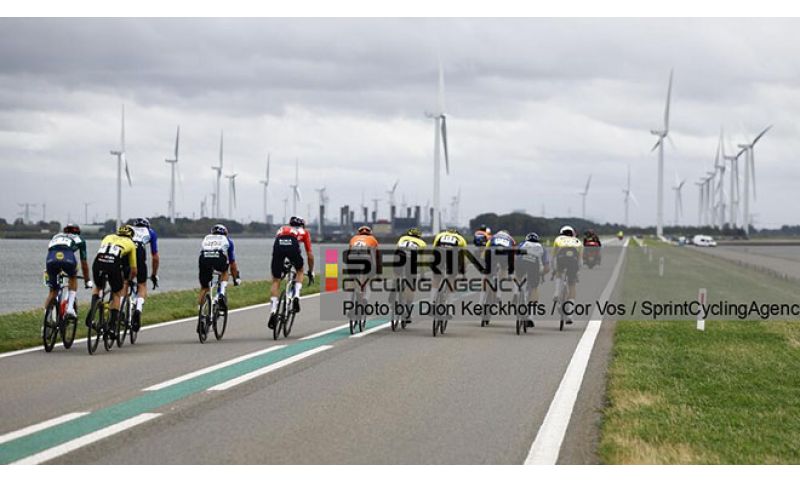
«In practice, the organizer has to act as a bank». Marco Selleri has condensed in his open letter in seven words one of the least discussed problems in professional cycling. It doesn't concern power dynamics within the peloton, watts or UCI rankings. It concerns something far more elementary: the time value of money.
A race lasts a few hours, sometimes several days. Its financial organization begins months before and can end many months after. In between there exists a subject who advances resources, enters into contracts, pays for services, assumes responsibilities and must meet deadlines that don't necessarily coincide with those of whoever promised them the funding. Selleri therefore raises an authentic problem. But it's worth measuring it.
Let's start with the rules. Article 1.2.076 of the UCI Regulations, in the version in force since February 2026, establishes for men's WorldTour, ProSeries and class 1 races, and for the corresponding women's categories, that participation fees must be paid within 30 days of the team's invoice issuance, which can be validly issued from the day following the conclusion of the race. We are therefore not in the realm of customs: there exists a temporally defined obligation. The figures help us understand the issue. In the UCI Road Financial Obligations 2026, for a European men's 1.1 race, the fee provided for each UCI WorldTeam or UCI ProTeam is 2,600 euros. If, purely as an example, there were eighteen teams belonging to these categories at the start, the organizer would already have 46,800 euros in participation fees to finance in the very short term.
That's not all. For a men's one-day class 1 race the minimum UCI prize pool for 2026 is 14,520 euros. To the sums allocated to prizes are added the contributions provided by the centralized management system: the UCI document indicates an additional 11.82 percent charged to the organizer for components allocated to CPA, career-end fund, national riders' association and platform management. In the terms of the previous example, participation fees and prize system would thus exceed 63,000 euros in total, before even discussing security, personnel, timing, television production, barriers, equipment, structures, insurance, communication and logistics.
In this case too it is essential to be precise. Not everything must be paid within thirty days. Article 1.2.071 provides, in the centralized prize system, that the organizer transfer the entire amount owed within 45 days of the race; article 1.2.072 then establishes the 90-day limit for payment to beneficiaries. It is precisely this articulation of deadlines that demonstrates how modern cycling is now also a regulated financial system.
To this are added logistical obligations. Article 2.2.010 requires, in international stage races, coverage of team accommodation according to the conditions provided and, for WorldTour, Women's WorldTour, ProSeries and class 1, also an additional night when schedules don't allow the team to return the same day. These are costs that translate into cash outflows immediately before or right after the event. Up to this point, however, I have illustrated only part of it, but it is at this point that the other half of the problem enters the scene: public funding.
Let's avoid a frequent misunderstanding here. Legislative Decree October 9, 2002, no. 231, which regulates payment delays in commercial transactions, ordinarily establishes 30-day terms in relations with public administrations, extendable under certain conditions up to 60. But the same regulation defines commercial transaction as a contract having as its object the supply of goods or services in exchange for payment of a price. A public contribution or subsidy, subject to granting, implementation of the activity, reporting, control and subsequent disbursement, cannot be automatically assimilated to a normal commercial invoice. Even the General Accounting Office of the State expressly distinguishes the commercial nature from the non-commercial nature of operations. It is in this difference that Selleri's phrase acquires a precise economic meaning.
If an organizer incurs the expense today and recovers a significant portion of resources after 240 or 270 days — a timeframe indicated by Selleri based on his own organizational experience, not a statistical average across the entire public administration — what is created is what in corporate finance we would call working capital requirement.
Let's do a simple exercise. If 400,000 euros must be advanced to organize a race and that liquidity remains tied up for 240 days, assuming only an annual financial cost of 6 percent, the theoretical cost of the advance is approximately 15,800 euros. At 270 days it rises to almost 17,800 euros. We haven't added bank commissions, cost of guarantees or risk of further delays. That money doesn't improve the route, doesn't increase the prize pool, doesn't buy an extra camera and doesn't make the race safer. It is simply the price of temporal misalignment.
This is why limiting ourselves to saying that «others have to wait too» risks moving the problem without solving it. The hotel owner, the service provider, the professional or the company that sets up the barriers also have employees, suppliers, taxes and cash needs. Transferring eight months of delay down the supply chain simply means transforming the organizer's credit into their supplier's credit.
The economically correct question is a different one: who finances the interval between when the race must pay and when the race can collect?
This is the knot that cycling will have to grapple with. Advances on contributions, revolving funds, factoring arrangements, guarantees, federal or mutual instruments could become subject matter equally important as safety regulations. Because a system that imposes increasing levels of professionalism on organizers must also be concerned with their financial sustainability.
It is no coincidence that in 2026 the UCI itself opened an international consultation on the future of professional cycling expressly including among the topics to be reconsidered the economic model, together with calendar, participation rules and safety, declaring the objective of building a stronger and more sustainable system. Selleri, therefore, grasps the point: today too often the organizer also acts as a bank, but perhaps the next step must be even more radical. A bank is remunerated because it lends money and assumes a risk. The organizer, instead, is asked to advance capital so that everyone else can race, work, be accommodated and be paid.
If we want to continue having races, especially those that don't have the commercial revenues of major international events, we will eventually have to recognize that the time needed to finance a race also has a cost, and that cost, as long as it remains invisible, will continue to rest almost entirely on the shoulders of whoever still decides to organize the race.



 1
1
 1
2
2
1
2
2


 Ritratti
 Oscar
Oscar Albi d'Oro


Se sei giá nostro utente esegui il login altrimenti registrati.