























Tom Boonen breaks his silence and during a television broadcast revealed: "Women would pinch my buttocks. I was considered a piece of meat"
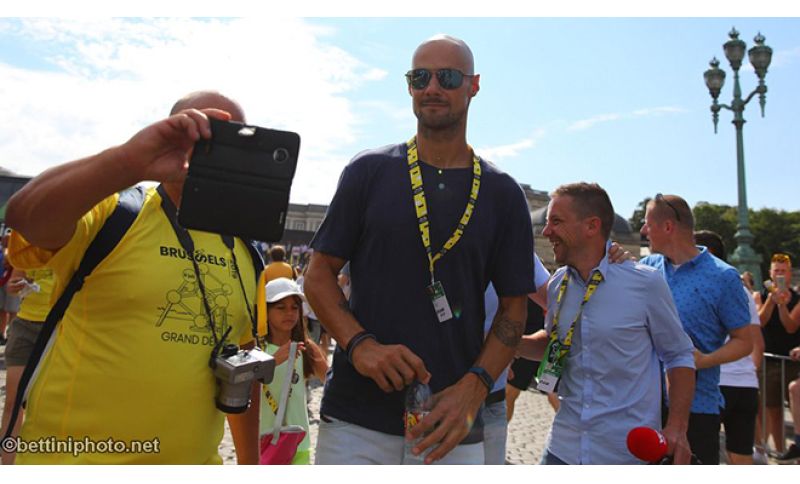
For many years it has been a difficult subject to address, almost a taboo. In cycling, as in sport in general, there has been frequent discussion of sexism, harassment and inappropriate behavior towards women. Much more rarely, however, has there been discussion of what can happen to men. It was Tom Boonen, one of the most important figures in Flemish cycling over the past twenty years, who brought the topic back into the spotlight by deciding to publicly share some experiences from his career.
The former world champion was a guest on "Happy Hour", the new program hosted by Ruben Van Gucht broadcast by Flemish broadcaster VTM. During the interview, Boonen spoke bluntly about several episodes of inappropriate sexual behavior that involved him when he was still very young and was becoming one of the great stars of international cycling.
"Women would pinch my buttocks before the start of races. At that moment, you are simply considered a piece of meat," Boonen recounted without holding back.
Strong words, spoken by a champion who for years was one of the most recognized men in the peloton. Boonen, four-time winner of Paris-Roubaix between 2005 and 2012 and world champion in Madrid in 2005, explained that the episodes were not limited to a few playful gestures or simple compliments, but often made him uncomfortable, leaving him unable to react.
"I was about 21 years old when I became famous. Often it was women between 45 and 50 years old". The Flemish rider also recounted being groped in the groin, emphasizing how difficult it was, especially for a young man, to find the courage to publicly say that certain behaviors made him uncomfortable.
"When you say it bothers you at 25 years old, people make fun of you". And this is precisely one of the most delicate aspects of Boonen's testimony. The problem is not only the gesture itself, but also the social perception that often accompanies harassment when the victim is a man. In an environment where the athlete is portrayed as strong, confident and always ready to joke, admitting to feeling violated or bothered can become particularly difficult.
Moreover, fame seems to transform the athlete's body into something public, as if it were part of the show. But a rider, even when he becomes an icon, remains a person and his body does not automatically become available to others.
Boonen's testimony comes at a time when the issue of the sexualization of cyclists has returned to the center of attention during the Vuelta a España.
After Tadej Pogacar's victory in the opening time trial, an influencer had directed some questions and comments at the Slovenian champion that sparked numerous reactions. Among the phrases directed at the rider was also the nickname "Pogachita", accompanied by the question: "Why do you hyperventilate every time you see me?"
Pogacar, visibly annoyed, responded with a quip: "I breathe 24 hours a day".
The incident sparked discussions among industry professionals. Eurosport Spain journalist Laura Meseguer called the comments sexist and criticized how the situation was handled. Subsequently, the influencer was banned from accessing the Vuelta route.
Beyond the single incident, the issue raised is broader: to what extent is it acceptable to turn an athlete into an object of comments about their body, appearance or sexuality?
Boonen's words add a perspective that is often ignored. The problem of harassment does not depend on the victim's gender. A woman can be a victim of sexually inappropriate behavior, just as a man can be. The difference often lies in the willingness to recognize the problem and the ability for those who experience it to speak about it without being ridiculed.
Boonen chose to do so many years after those episodes, when his career already belonged to cycling history. And precisely for this reason his testimony carries particular weight.
At 21 he had already become a star. His name was everywhere, his victories had transformed him into an idol and thousands of people wanted to get close to him. But behind the champion there was still a young man who, as he recounted, could feel uncomfortable in the face of certain behaviors.
Success does not erase the right to privacy. And a trained, exposed and admired body on the roads of races is not a body at the disposal of the public.
Tom Boonen's confession thus arrives as an important reflection on the world of sport: talking about respect means doing so for everyone, without distinction. Because harassment does not become less serious simply because the victim is a man, just as a sexist comment does not stop being such when directed at a champion celebrated by millions of fans.
After years spent in the spotlight, Boonen chose to share a lesser-known part of his experience. And that phrase, "you are simply considered a piece of meat", remains perhaps the most significant passage of his testimony: behind every athlete, even before the champion, there is a person who deserves respect.

 16
16


 16
16


 4
4
5
5
3
3
4
4
5
5
3
3


 Ritratti
 Oscar
Oscar Albi d'Oro

