


















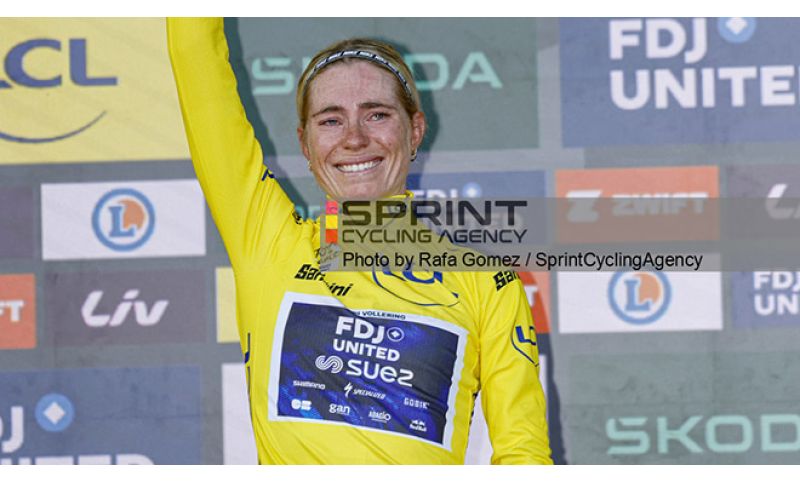
Demi Vollering waited until the final day to put her most important seal on the race. But when the decisive moment arrived, the Dutch champion racing for FDJ United – SUEZ, left no room for doubt. She is the winner of the Tour de France Femmes 2026. She crosses the finish line in Nice with the yellow jersey on her shoulders. And above all, she writes a new page in the history of the race: Vollering is the first cyclist to win the Tour de France Femmes twice.
A success built in the mountains, defended with her team and finally sealed with a solo effort of 16 kilometers. The final stage was not simply a procession into Nice. The duel with Kasia Niewiadoma transformed the closing stage into a real battle, intense, full of tactics and tension. And in the end it was Demi Vollering who had the last word.
The day had started with all eyes on the confrontation between the yellow jersey wearer from FDJ United-SUEZ and the Polish rider from CANYON//SRAM, second in the general classification and determined to try until the very end to overturn the Tour. There was also a particular atmosphere surrounding the race. Niewiadoma's statements after the previous day's stage had sparked a discussion about the tactics of Vollering's team and, in particular, the behavior of Célia Gery. The French rider had been targeted on social media to the point of even receiving death threats. Despite everything, she presented herself regularly at the start on the Promenade des Anglais, ready to do her job for the leader.
The Tour, however, had not yet had its final say.
Mavi Garcia was the first to light the fuse. The objective was to immediately put pressure on Elisa Longo Borghini, fourth in the general classification three minutes behind the yellow jersey. The pace became extremely high from the first kilometers and Lorena Wiebes took advantage of the situation to definitively secure the green jersey.
Niewiadoma's team transformed the stage into an elimination race, progressively thinning out the group of favorites. Célia Gery was forced to drop back, leaving Vollering with only Juliette Berthet in a group of twelve athletes. The strategy was clear: isolate the yellow jersey and try to put Vollering under pressure.
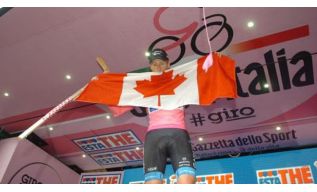
45 kilometers from the finish, Isabella Holmgren launched her attack, immediately gaining ground. The Canadian built an important margin, but as the decisive climbs approached, her advantage began to diminish. On the penultimate ascent it had dropped to one minute. At the start of the final lap, only thirty seconds remained. The race was entering its decisive moment.
It was Antonia Niedermaier who did the most important work for CANYON//SRAM. The German imposed a grueling pace on the final climb, bringing Niewiadoma and Vollering close to Holmgren.
For the Polish rider, that was the right moment to attack. Niewiadoma accelerated decisively, trying to break free from her rival and transform the final kilometers into a long solo chase toward Nice. Her attack caused a selection, but it failed to make the difference that was needed.
The Dutch champion responded without losing her composure. She let Niewiadoma set the pace, studied the situation and waited for the right moment. Then she accelerated.
The first acceleration was not enough to drop the Polish rider. Niewiadoma resisted. But Vollering still had one last card to play. About 500 meters from the summit of Col d'Èze came the decisive blow. This time Niewiadoma had no answer. Vollering opened up, gained meters and launched herself toward Nice alone. Sixteen kilometers of solo breakaway, sixteen kilometers to transform a yellow jersey still under pressure into a definitive victory.
At the finish line, Vollering released all the tension accumulated during a day that was worth an entire season.
"I was thinking about so many things," she said after the finish. "I had never won a stage in the yellow jersey before. I was thinking about my team, about Célia, who had a really, really difficult night. I was thinking about all the hard work, about the people who support me and those who prepared my bike perfectly for me".
The second Tour de France is not just a trophy. It is the confirmation of a career at the highest level, of a cyclist who knew how to bounce back, learn from defeats and return to conquer the most important race on the calendar.
"The people around me are incredible. It's not just a dream to win here, but also simply to live this life, with all these people around me".
At the end there was also a moment of confrontation with her direct rival. Vollering recounted speaking with Niewiadoma during the race: "I told her it was fine that Elisa Longo Borghini came back, to make her work a bit. After that, I had to try to attack and go solo".
She didn't simply want to defend her advantage. She wanted to close out the Tour with a sporting response after the controversy of the previous day. "We wanted to show that we didn't win here because of an incident yesterday. We won thanks to a beautiful Tour, with humility and pride".
A statement that perfectly explains the significance of this victory.
The victory takes on even greater value when thinking about what happened on Mont Ventoux. Niewiadoma had taken the yellow jersey with an extraordinary solo effort and seemed to have taken control of the race. Vollering, on the other hand, had been forced to chase. But the Dutch rider never stopped believing. "Did I have doubts after Mont Ventoux? Certainly not. I just took a bit too much risk. But that's sport: sometimes you win and sometimes you lose". And in the end it was she who chose the perfect moment to attack. First Niewiadoma on Ventoux. Then Vollering on Col d'Èze. Two champions, two attacks, two days that decided an extraordinary Tour.
In Nice, however, the story belongs to Demi Vollering. The Dutch champion wins her second Tour de France and becomes the first cyclist in the history of the race to achieve this. A feat that projects her even higher in the record books and comes after a finale worthy of the great races: the yellow jersey on her shoulders, the road ahead of her and sixteen kilometers alone to put an end to any doubt.
And as Nice applauds the new queen of the Grande Boucle, Vollering is already looking beyond. "I still have dreams, both on the bike and off it, and I want to achieve them".
For now, however, she can enjoy the greatest of all: returning to the throne of the Tour de France.

 2
2


 2
2


 1
1
1
1
1
1
1
1
1
1
1
1

 Ritratti
 Oscar
Oscar Albi d'Oro

