















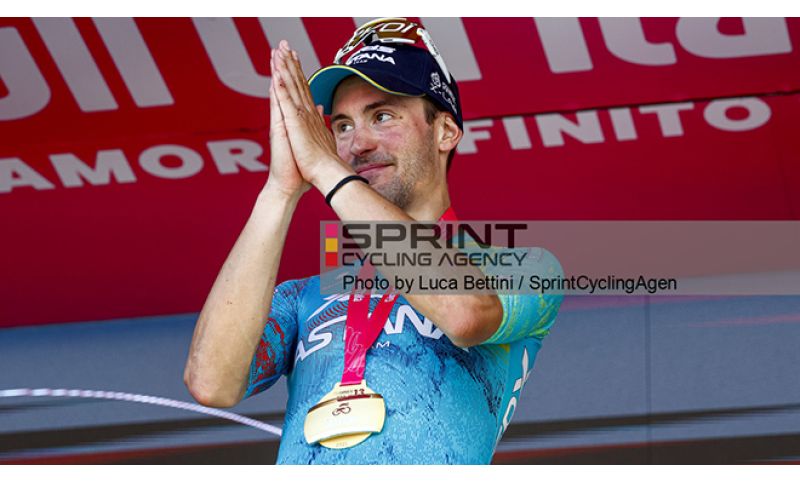
There are victories that cannot be explained by strength alone. They are explained by instinct, by reading the moment, by that fraction of a second in which a rider understands that the race has opened a crack and that he must enter that crack without hesitation. Alberto Bettiol, at Verbania, won this way: not waiting for the sprint, not managing the breakaway, not calculating conservatively, but transforming the final climb of the day into the technical threshold of a decision.
The thirteenth stage of the 2026 Giro d'Italia, 189 kilometers from Alessandria to Verbania, could have seemed like a transition day, one of those stages in which the general classification catches its breath and the breakaway takes possession of the scene. But it is precisely in the intermediate stages that the noblest terrain of author's cycling hides. On the Ungiasca climb, Bettiol let the race mature, measured Leknessund and then produced the decisive acceleration. Not just any attack: a sharp, almost surgical change of pace, delivered at the point where the opponent had already spent energy and the finish line was still far enough away to require courage. Then the descent, the lines, the relaunching, the wind management. Thirteen kilometers alone: enough to transform an attack into a verdict.
In that gesture, another image came to mind, thirteen years distant but close in cycling grammar. It was May 22, 2013, and Giovanni Visconti won at Vicenza the seventeenth stage of the Giro, from Caravaggio to Vicenza. Then too the finale contained a small climb, the Crosara, sufficient not to select the great climbers, but to offer the intelligent rider the breaking point. Visconti departed about sixteen kilometers from the finish, caught those remaining from the breakaway, dropped Rubiano and Di Luca, painted the descent and defended to the line an advantage that the peloton could no longer close.
Bettiol at Verbania and Visconti at Vicenza belong to the same technical family: that of riders who do not wait for the race to decide for them, but force it to take a shape. The finisher is not simply a final attacker. He must have power, certainly, but above all inner timing, tactical lucidity, aerodynamic sensitivity, the ability to read the organization of those chasing. He knows that his margin is not only in watts, but in the uncertainty he produces behind him. When he attacks well, the peloton must not only chase: it must decide who chases, when, with what conviction, sacrificing which interest.
This is where modern cycling seems to have lost something. The exasperation of control, the centrality of team trains, the scientific measurement of effort and the rigidity of team roles have made that ancient gesture of the rider who breaks the pattern rarer. The finisher instead lives in creative disorder. He does not reject the science of racing, but uses it against predictability. He knows thresholds, gradients, curves, remaining distance; yet, in the decisive moment, he adds a variable not entirely measurable: the courage to anticipate.
Bettiol's victory, like Visconti's, reminds us that cycling is not merely a sum of data, nor pure mechanics of performance. It is also the art of irreversible choice. When Bettiol passed Leknessund near the summit and stretched toward Verbania, he performed a gesture that belongs to the best Italian tradition: that of the complete rider, capable of suffering on climbs, guiding on descents, pushing on flats and above all feeling the race before others.
A victory like this is worth more than its finishing position. It is worth as technical memory. It says that the finisher has not disappeared: he has become rarer, because today to succeed he must beat not only his opponents, but also the tactical algorithm of contemporary cycling. When he manages it, as Bettiol did yesterday and as Visconti did thirteen years ago, the race finds one of its purest forms: the attack born from intuition, becomes solitude and arrives at the finish line as a small work of art.



 7
7
 7
1
1
1
1
4
4
2
2
7
1
1
1
1
4
4
2
2

 Ritratti
 Oscar
Oscar Albi d'Oro


Se sei giá nostro utente esegui il login altrimenti registrati.