















There is a place, in the Cuneo countryside, where cycling still preserves a soul. In Ruffia, three hundred and fifty inhabitants and silences as long as provincial dirt roads, time is in no hurry to pass. That's where Italo Zilioli lives. A former rider, a former promise of an Italy desperately seeking a new Coppi, a former eternal second by journalistic definition. But above all, a rare man. One of those who, when they start telling stories, aren't simply speaking: they're pedaling again.
Listening to him means entering a cycling that no longer exists. Not the one of watt bikes, shared files, and radios barking orders. The cycling of real thirst, counted water bottles, attacks born of instinct, and crises faced without knowing how many kilometers truly remained to the finish. A cycling where the legs spoke directly to the heart, without filters.
Italo Zilioli belongs to that world. And perhaps that's why even today, after hours of conversation, when we say goodbye, there remains the sensation of having encountered something that goes beyond sport. To have the privilege of listening to Italo Zilioli speak about cycling means entering a different time. Slower only in appearance. Because then he accelerates, changes rhythm, opens a memory, and suddenly you find yourself in a breakaway with him on roads from sixty years ago.
It always happens this way. First comes the mild smile, almost shy. Then his eyes light up. And then cycling is no longer a sport: it becomes living memory, melancholy at times, friendship, effort, youth that endures.
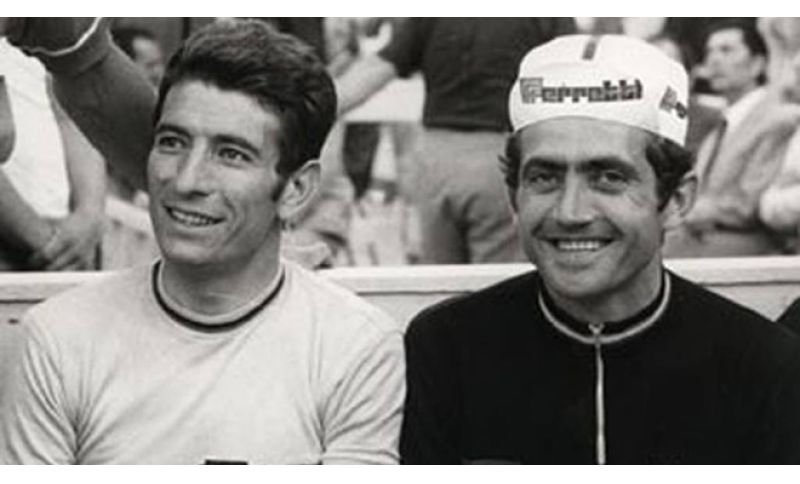
He, Gigi Mele, and Franco Balmamion were separated by just four years. Gigi, born in '37, a Neapolitan adopted by Piedmont, left behind an enormous void. Franco, the oldest among the Giro winners still living, remains the intelligent champion, the crystal-clear calculator of the '62-'63 double. And then there's Italo, born in 1941, the gentle boy on whom Italy had the mad idea of projecting the impossible shadow of Fausto Coppi. Three friends. Three proud men. Three different ways of being on a bicycle and in life.
When Italo speaks of Gigi, his voice always changes slightly. It becomes lower, softer. Because certain bonds need no explanation. And today, without Gigi, Franco and Italo seem to guard together a cycling that no longer exists, made of shared rooms, silences, real suffering, and attacks without calculations.
Naples 1963: "What the hell was I thinking?" Among the memories that resurface most often is one that still makes him smile today. Giro d'Italia 1963, departure from Naples toward Potenza.
«An immense spectacle - he recounts -. A quantity of people in love with the Giro and the riders that today I struggle even to explain».
He was young, instinctive, incapable of racing while thinking about caution. After about fifty kilometers, under ferocious heat, a small climb of just a few kilometers came. And he attacked.
«That's how I was».
Behind him, all the best climbers in the general classification immediately moved. The stage became hell. Crises, enormous gaps, riders scattered on the mountains like survivors. He arrived in Potenza destroyed along with other young riders like Partesotti and Poggiali, repeating to himself: but what was I thinking?
Yet within that madness was already all of Italo Zilioli.
The inability to manage himself.
The dangerous beauty of instinct.
The almost physical need for freedom.
A madness of a boy in love with racing. The kind that empties your legs and marks your mind. He arrived dropped, destroyed, asking himself repeatedly: but what the hell was I thinking?
Yet it was precisely in that Giro that he understood he could truly stand among the greats. It happened on Mont Blanc, toward Saint Vincent. Ahead, in the good group, there was also Gigi. That day Italo intuited his own destiny. Not that of a dominator. That of a true rider.
The poignant art of arriving second.
Three times second at the Giro d'Italia. Behind Anquetil, Adorni, Motta. Second even in the last race of his career, at the 1976 Giro dell'Emilia. Yet reducing Italo Zilioli to the label of eternal second means having understood nothing of his story. Because Zilioli was never a rider built to control. He didn't know how to manage the race like Balmamion, who "sought with intelligence to eliminate opponents spending as little as possible". He didn't have Anquetil's mathematical cynicism. And neither the devouring ferocity of Merckx.
Italo raced by instinct. Always.
«Stage races demand management - he says today -. But I was someone who attacked. Always aimed at victory, without making calculations».
And it's probably for this reason that he still moves people so much. Italo didn't remain in people's hearts for his placements. He remained there for that elegant restlessness of his, for the instinctive and almost romantic way of being inside the race.
He suffered from expectations. The nights before decisive stages became torments. He felt fragile precisely when the world demanded absolute greatness from him. And perhaps that's why he still moves people today.
Because perfect champions impress. Vulnerable men endure.
Merckx, the yellow jersey, and that phrase that explained everything
In 1970 he won in Angers and wore the yellow jersey at the Tour de France. An immense dream. He held it for five days. Then Amiens arrived and the Tour returned to the hands of giants. But what truly remained with him was a phrase from Eddy Merckx, captain and roommate.
«Remember that the Tour is long and today you've worked hard». Within those words was already all of the Cannibal. The difference between those who attack following their heart and those who govern the world using their head as well.
«There I understood that Eddy raced with his brain as well as his legs». Yet, despite everything, Merckx remained one of his dearest friends. Even today they speak often. Even today Italo tells of how, at the table, riders remained amazed before his impossible accelerations.
«He always said: legs don't have a head». Merckx reasoned. Calculated. Dominated. Zilioli instead raced like someone who feels the wind on him and that's it.
«I liked going fast downhill. They said I was crazy. I felt free»».
Free. It's the word that returns most often in his stories. More than victories. More than regrets. Perhaps because Italo Zilioli never truly wanted to become a machine. He never fully learned to suffocate doubts, fears, sensitivity. And in the fierce cycling of the Sixties, this had the highest price.
The Campania Tour and the Albricci reborn
Then there's a memory that always brings him back willingly to Naples. Giro della Campania 1964. Four remain ahead. At the Albricci finish, Vito Taccone wins ahead of Zilioli. «Italo arrived second there too», he himself recounts laughing.
But it's not the placement that matters. It's the image. The Albricci ring full of crowds. The shouts. The bicycles entering the track. Naples that seems to want to embrace the riders. When he discovers that today that velodrome is coming back to life thanks to cycling schools and the recovery of the facility, his eyes light up.
«It's a beautiful thing. You don't live only on memories». And it's perhaps the most important phrase of all.
Today's cycling? «I prefer the accordion».
Italo still watches the Giro every day. But without toxic nostalgia. Without the need to say that everything was better before. Just different. «Today I often prefer the accordion to stage finales - he jokes -: it's a different cycling».
But then the analysis becomes crystal clear. Very modern. He talks about team cars, wattages, strategies, times to sustain, calculated breakaways to the second. He says everything has become schematic. That technology has ended up removing space for improvisation. «But going back is impossible».
And indeed he doesn't judge. He observes. He understands. On this Giro d'Italia he has very clear ideas. For him the race has already taken a precise direction. «So far the only ones who have tried to liven up the race are Vingegaard and Pellizzari».
Zilioli observes the Dane with authentic respect. He knows how to recognize great champions because he's truly lived with them. «Vingegaard already demonstrated in the second stage that he can make the difference when he wants».
But in his eyes there's above all curiosity for Giulio Pellizzari, the Italian boy who wasn't frightened before the strongest. «I liked how he responded to the attacks».
And then he already points out the stages that can change the Giro. The Blockhaus, today, after 244 grueling kilometers. And especially the following Sunday, with the finish at altitude on Corno alle Scale. «There we'll truly understand who can win».
He says it with the calm of someone who still feels cycling on him like an ancient fever.
Milan, Magnier, and the measure of sprints
Jonathan Milan also falls under the delicate but crystal-clear lens of Zilioli. «He's the disappointment of this Giro's beginning». Not out of malice. Because Italo sees in him an enormous engine, yet still incomplete in management. «In the first stage he started late. In Sofia too early».
Paul Magnier, instead, seemed to him more shrewd. Colder. More precise in reading the exact moment of the sprint. «If Milan finds the right measures, he can return to being dominant».
Once again, the theme is always the same: cycling is not only strength. It's balance between instinct and control. Between heart and management. The difference between Merckx and Zilioli, after all, was all there.
First at the finish line of life
Then the conversations end. But with Italo they never truly end. He returns to his Ruffia, to the silences of the Cuneo countryside, to the accordion, to the guitar, to phone calls with Merckx, to memories of Franco Balmamion and Gigi Mele that resurface continuously like old photographs never faded.
And you remain there thinking that perhaps cycling lost something enormous when it stopped leaving space for restless, romantic, imperfect riders.
Those like Italo Zilioli. The man who arrived second infinite times. But who at the finish line of life, with that fragile and gigantic humanity of his, arrived first by a distance.

 2
2


 2
2


 2
2
11
11
5
5
25
25
1
1
3
3
5
5
2
2
11
11
5
5
25
25
1
1
3
3
5
5

 Ritratti
 Oscar
Oscar Albi d'Oro

