Tour de France 1948. On July 16th – a Friday – the fourteenth stage is raced, the Briançon-Aix-les-Bains stage of 263 km, with five mountains to climb: Galibier, Croix de Fer, Porte, Cucheron and Granier. The day before, Gino Bartali won and recovered the yellow jersey from Louison Bobet, gaining more than 18 minutes, and in the standings he is trailing him, besieging him, suffocating him by just one minute and 6 seconds. Now that would be a substantial gap, but back then, for Bartali, with all those climbs, it was nothing.
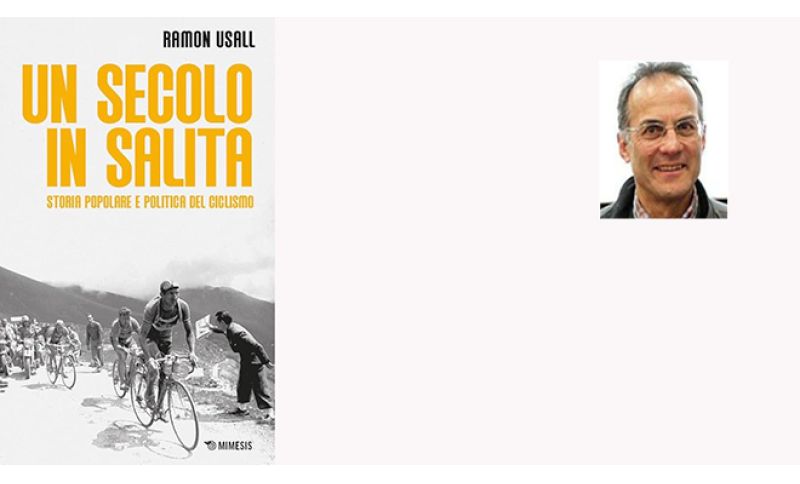
The cover photo of "A Century Climbing" captures Bartali and Bobet on the Croix de Fer. Gino standing on the pedals, Louison sitting in the saddle. Gino with his cap and motorcyclist goggles over his cap, Louison bareheaded. Gino looking into the distance, Louison at eye level. Gino who still seems fresh, the dance of the climber, Louison already fatigued, the gait of the all-rounder. So much so that Gino will attack, Louison will defend. So much so that Gino will drop him, Louison will fall back. At the finish line Bartali will triumph, the second of three consecutive victories, almost six minutes ahead of Belgian Stan Ockers in second place, more than seven minutes ahead of Bobet in sixth, and in the standings, thanks also to time bonuses, he will lead by 8'03".
Yet the true protagonist of the cover of "A Century Climbing" is not Bartali despite the demonstration of his strength nor Bobet despite the degree of his suffering, but rather that spectator, the first one on the right, elegant in his formal dark suit, the jacket perhaps double-breasted, the baggy trousers, the white shirt and tie, white socks and low lace-up shoes, hair combed if not slicked back, a newspaper grasped in his right hand and waved to encourage, to push, to celebrate, having perhaps walked all the way up there where clouds rest on the peaks. That man – a man of the people even if, to the eye, well-to-do – receives, from cycling, from the highest level of cycling, a message, beyond an electric human shock, between sport and spectacle, between passion and emotion. And the message is political. Because the bicycle of cycling, writes Ramon Usall, is "a faithful symbol of its own time, because it contributed to, or took part in, many of the historical and social phenomena that happened around it".
"A Century Climbing" (Mimesis, 298 pages, 20 euros), in 40 chapters, traverses a century of "popular and political history of cycling". From the Dreyfus affair, at the foundation of the birth of the Tour de France in 1903, until the disappearance of the Porto-Lisbon race, capable of reflecting the history of Portugal, the last edition held in 2004, and at that time it was the longest one-day race in the world (approximately 340 km). Sport is political, it is always political, if it is true that politics is, according to the ancient Greeks, the art of living together. And the Tour of Flanders (here the 1913 edition is examined) and the Tour of the Basque Country (here the 1924 and 1932 editions are discussed) were pervaded with nationalist spirit. And one of the most iconic images of Michael Collins, head of IRA intelligence, the Irish Republican Army, depicts him standing on a bicycle. And the same Bartali of the 1948 Tour, before his three days of glory, apparently received a telephone call from Alcide De Gasperi, head of Government and Christian Democrat leader, after the attack on Palmiro Togliatti, secretary of the Communist Party, with the effect of averting a revolt or revolution. And the 1968 Vuelta of Spain was raced amid attacks and repression, rifles protruding from the team cars, in a battle not only between Felice Gimondi (later winner) and José Pérez Francés, but also between Francoists and Basque separatists. And the 1981 Coors Classic, in Colorado, reproduced on pedals the Cold War between the United States and the Soviet Union.
Among better-known stories, such as that of German sprinter Albert Richter, anti-Nazi during Nazism, there are others less frequented, such as that of Dutchman Joop Zoetemelk, who on the eve of turning professional competed in and won the Tour of Yugoslavia, which aimed to highlight the characteristics of a country so divided yet so united: "Six republics, five nationalities, four languages, three religions, two alphabets and one leader". Che Guevara, who knew about these things, added: "Zero chance of survival". And he was right, despite cycling's unifying mission.
The same Che Guevara who held a conviction: "Revolution is like a bicycle: when it stops moving forward, it falls". Who knows, perhaps that man on the roadside of the Croix de Fer already knew that too.























 Ritratti
 Oscar
 Albi d'Oro


Se sei giá nostro utente esegui il login altrimenti registrati.