Naples, Velodromo dell'Arenaccia, almost 600 meters, the longest in Italy. In the select group of the leaders, Franco Bitossi attacks "like a kamikaze", "launches himself forcefully", "to attempt a solo" and "shatters the sprinters' plans". The only one chasing him is a world champion of the pursuit, "an Altig who burns himself to close the gap". "And then comes the lightning strike of Dino Zandegù". Zandegù first, who "wins decisively" and "shouts it stenoriously to the sky and the stands – free admission to the Velodromo".
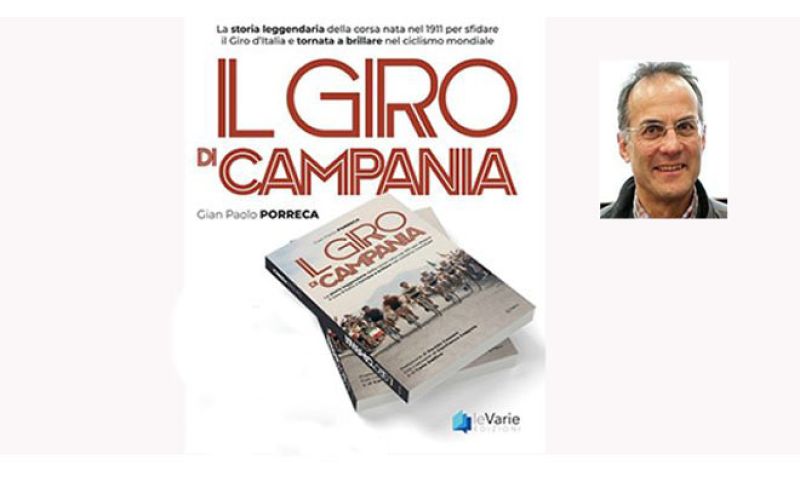
Giro di Campania 1967. It's one of the 64 editions of a race born in 1911 to challenge the Giro d'Italia, which that very year had dared to arrive in Pompeii and not, as planned, Naples, and which would depart from Caserta and not, as planned, Naples. And it's one of the chapters of the book "Il Giro di Campania", a long declaration of love by Gian Paolo Porreca to cycling, to races and riders, to the bicycle. Also a tribute to his Campania. And above all a hymn to life. Pedaling is living at a silent speed. An elegant paperback, 208 pages, 16 euros, published by LeVarie, enriched by the preface of Davide Cassani and the stories of Gianfranco Coppola and Carlo Delfino. On the cover, paired at the head of the race, for the first time together, Guerra, Bartali, Coppi (in the rainbow jersey), Moser and Saronni.
But the story is richer than the rich. Starting with Giuseppe Pifferi, who was not rich, but who in the second edition, that of 1913, won all three stages and obviously the final classification, and perhaps became enriched, if not with money, certainly with compliments and memories. Little is known of him: Roman, he raced for Peugeot, Maino and Verdi, perhaps for whoever lent or gave him a wool jersey, his career as a rider interrupted but not broken by the misfortune of the First World War, victories (at the Giro dei Tre Mari) and podiums (at the Roma-Napoli-Roma) always gained in the South.
There is no edition that doesn't offer surprises. Races are mysteries at the start and novels at the finish. The story of Alberto Temponi, in the only photograph that testifies to his existence, motorcyclist goggles, a miner's face, the only Campanian winner of the race, in 1927. The story of Adolfo Grosso, from Treviso, "a romantic medieval hero" as Orio Vergani would have described him, alone at the Arenaccia in 1953, "a superb feat of an obscure athlete". The story of Silvano Ciampi, Tuscan, who for his 1962 victory received as a prize – so it's said – a little lamb. The story of Van Linden, the first foreigner to conquer the Campania, it was 1976, for the Belgians he was Rik III after Van Steenbergen and Van Looy. Up to the story of Eric Antonio Fagundez, Uruguayan, first of five foreign athletes in the top five positions, "arriba arriba" in 2026.
But beyond the chronicles and statistics, Porreca's "Il Giro di Campania" is a jewel of poetry. Poetry expressed through two wheels, conjugated with hardship, marked by lives. "It is a frozen time, the Giro di Campania", Porreca introduces. "We approached it with caution and respect, prudent and subdued". Porreca does this by measuring his tones, calibrating his words, caressing memories. A work of great class.
























 Ritratti
 Oscar
 Albi d'Oro


Se sei giá nostro utente esegui il login altrimenti registrati.